

OceanBase logo

OceanBase

A unified distributed database ready for your transactional, analytical, and AI workloads.

Product Overview
DEPLOY YOUR WAY

OceanBase Cloud

The best way to deploy and scale OceanBase

OceanBase Enterprise

Run and manage OceanBase on your infra

TRY OPEN SOURCE

OceanBase Community Edition

The free, open-source distributed database

OceanBase seekdb

Open source AI native search database

Customer Stories

Real-world success stories from enterprises across diverse industries.

View All
BY USE CASES

Mission-Critical Transactions

Global & Multicloud Application

Elastic Scaling for Peak Traffic

Real-time Analytics

Active Geo-redundancy

Database Consolidation

Resources

Comprehensive knowledge hub for OceanBase.

Blog

Live Demos

Training & Certification

Documentation

Official technical guides, tutorials, API references, and manuals for all OceanBase products.

View All
PRODUCTS

OceanBase Cloud

OceanBase Database

Tools

Connectors and Middleware

QUICK START

OceanBase Cloud

OceanBase Database

BEST PRACTICES

Practical guides for utilizing OceanBase more effectively and conveniently

Company

Learn more about OceanBase – our company, partnerships, and trust and security initiatives.

About OceanBase

Partner

Trust Center

Contact Us

International - English
中国站 - 简体中文
日本 - 日本語
Sign In
Start on Cloud

OceanBase

A unified distributed database ready for your transactional, analytical, and AI workloads.

Product Overview
DEPLOY YOUR WAY

OceanBase Cloud

The best way to deploy and scale OceanBase

OceanBase Enterprise

Run and manage OceanBase on your infra

TRY OPEN SOURCE

OceanBase Community Edition

The free, open-source distributed database

OceanBase seekdb

Open source AI native search database

Customer Stories

Real-world success stories from enterprises across diverse industries.

View All
BY USE CASES

Mission-Critical Transactions

Global & Multicloud Application

Elastic Scaling for Peak Traffic

Real-time Analytics

Active Geo-redundancy

Database Consolidation

Comprehensive knowledge hub for OceanBase.

Blog

Live Demos

Training & Certification

Documentation

Official technical guides, tutorials, API references, and manuals for all OceanBase products.

View All
PRODUCTS
OceanBase CloudOceanBase Database
ToolsConnectors and Middleware
QUICK START
OceanBase CloudOceanBase Database
BEST PRACTICES

Practical guides for utilizing OceanBase more effectively and conveniently

Learn more about OceanBase – our company, partnerships, and trust and security initiatives.

About OceanBase

Partner

Trust Center

Contact Us

Start on Cloud
编组
All Products
    • Databases
    • iconOceanBase Database
    • iconOceanBase Cloud
    • iconOceanBase Tugraph
    • iconInteractive Tutorials
    • iconOceanBase Best Practices
    • Tools
    • iconOceanBase Cloud Platform
    • iconOceanBase Migration Service
    • iconOceanBase Developer Center
    • iconOceanBase Migration Assessment
    • iconOceanBase Admin Tool
    • iconOceanBase Loader and Dumper
    • iconOceanBase Deployer
    • iconKubernetes operator for OceanBase
    • iconOceanBase Diagnostic Tool
    • iconOceanBase Binlog Service
    • Connectors and Middleware
    • iconOceanBase Database Proxy
    • iconEmbedded SQL in C for OceanBase
    • iconOceanBase Call Interface
    • iconOceanBase Connector/C
    • iconOceanBase Connector/J
    • iconOceanBase Connector/ODBC
    • iconOceanBase Connector/NET
icon

OceanBase Cloud Platform

V4.3.3

    Download PDF

    OceanBase logo

    The Unified Distributed Database for the AI Era.

    Follow Us
    Products
    OceanBase CloudOceanBase EnterpriseOceanBase Community EditionOceanBase seekdb
    Resources
    DocsBlogLive DemosTraining & CertificationTicket
    Company
    About OceanBaseTrust CenterLegalPartnerContact Us
    Follow Us

    © OceanBase 2026. All rights reserved

    Cloud Service AgreementPrivacy PolicySecurity
    Contact Us
    Document Feedback
    1. Documentation Center
    2. OceanBase Cloud Platform
    3. V4.3.3
    iconOceanBase Cloud Platform
    V 4.3.3
    Databases
    • OceanBase Database
    • OceanBase Cloud
    • OceanBase Tugraph
    • Interactive Tutorials
    • OceanBase Best Practices
    Tools
    • OceanBase Cloud Platform
    • OceanBase Migration Service
    • OceanBase Developer Center
    • OceanBase Migration Assessment
    • OceanBase Admin Tool
    • OceanBase Loader and Dumper
    • OceanBase Deployer
    • Kubernetes operator for OceanBase
    • OceanBase Diagnostic Tool
    • OceanBase Binlog Service
    Connectors and Middleware
    • OceanBase Database Proxy
    • Embedded SQL in C for OceanBase
    • OceanBase Call Interface
    • OceanBase Connector/C
    • OceanBase Connector/J
    • OceanBase Connector/ODBC
    • OceanBase Connector/NET
    • V 4.3.6
    • V 4.3.5
    • V 4.3.4
    • V 4.3.3
    • V 4.3.2
    • V 4.3.1
    • V 4.3.0
    • V 4.2.2
    • V 4.0.0 and earlier

    Create an arbitration service

    Last Updated:2026-04-20 07:21:01  Updated
    Share
    What is on this page
    Prerequisites
    Procedure
    Startup parameters

    folded

    Share

    This topic describes how to create an arbitration service.

    Applicability

    This topic applies only to OceanBase Cloud Platform Enterprise Edition. OceanBase Cloud Platform Community Edition does not support the arbitration service.

    Prerequisites

    The host for deploying an arbitration service has not been deployed with any OceanBase Database cluster.

    Procedure

    1. Log on to the OceanBase Cloud Platform (OCP) console.

    2. In the left-side navigation pane, click Clusters.

    3. Click the Arbitration Service tab to view the cluster arbitration service list.

    4. On the Arbitration Service List page, click Create Arbitration Service.

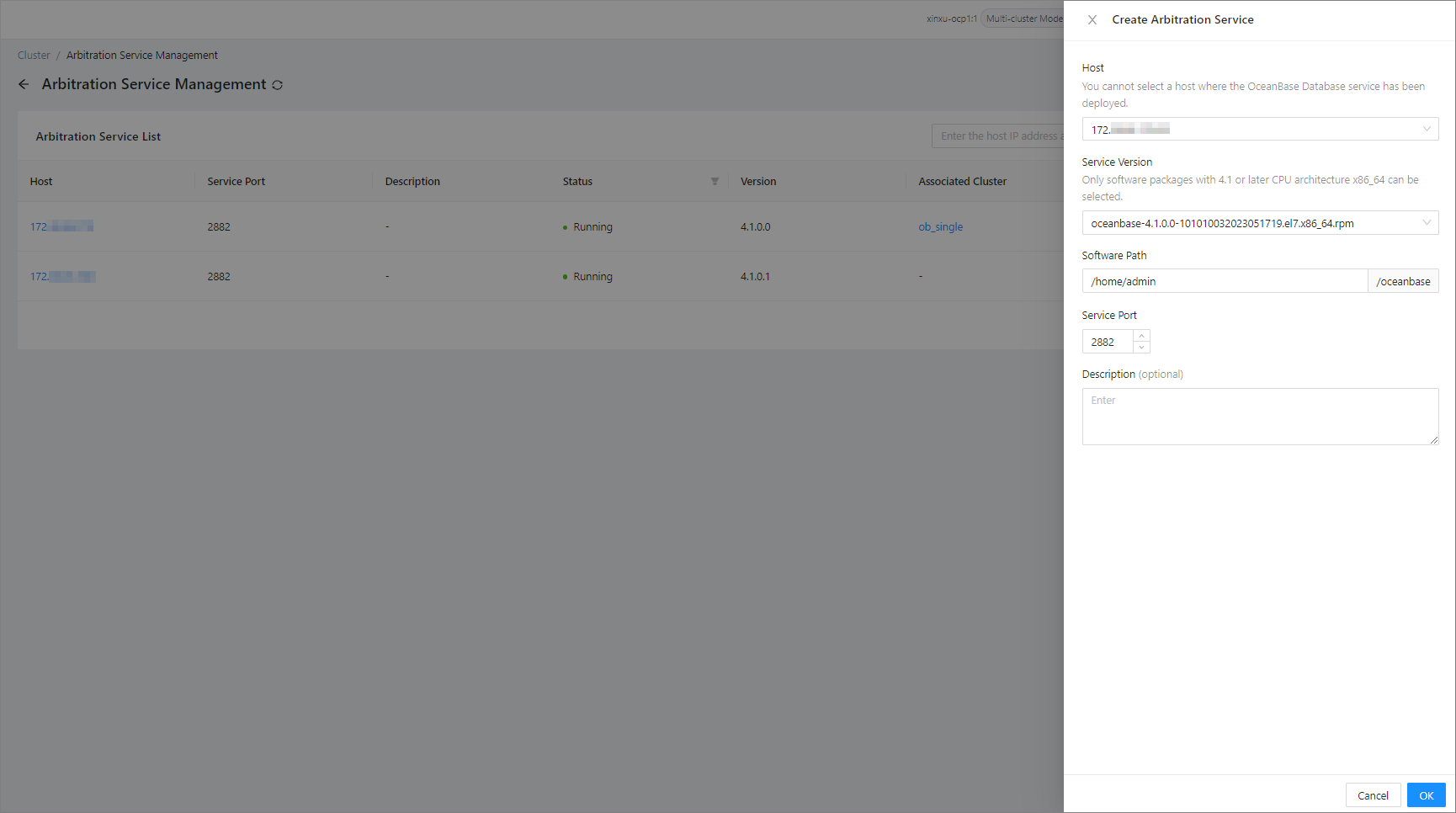
    5. In the Create Arbitration Service panel, configure the basic information of the arbitration service.

      Parameter
      Description
      Host The host for deploying the arbitration service. You can deploy multiple arbitration service processes on the same host. You can search for hosts by IP address or click Add Host in the drop-down list to add an available host.
      Service Version The OceanBase Database version of the cluster. The hardware architecture of the selected version must be the same as that of the host. Only software packages of OceanBase Database V4.1 or later are supported. You can also click Add Version at the bottom of the drop-down list to upload a software package of the required version.
      OS User The OS user that you use to install and run OceanBase Database. You cannot edit this parameter here. You can change the default value of the ocp.operation.default.os.user parameter to set this user. For more information, see Modify system parameters.

      Note

      The modification of the ocp.operation.default.os.user parameter affects only the following operations: create a distributed cluster, create an OBProxy cluster, and create arbitration service. Other settings of existing clusters are not affected.
      Software Path The path where the arbitration service software is installed. You must have the write permission on the path on the host.
      • If the OS user is admin, the default software installation path is /home/admin/oceanbase. You can change the path.
      • If the OS user is not admin, the default software installation path is /opt/oceanbase/oceanbase. You can change the path.
      Service Port The port of the arbitration service. By default, Port 2882 is used. You can use a custom port based on your business requirements. Make sure that the port is not occupied.
      Description The supplementary description of the arbitration service. This parameter is optional.
      Parameter Configurations The startup parameters of the arbitration service. For more information, see Startup parameters.
    6. Click OK. In the window that appears, click the task ID to view the task execution status.

      The system verifies the parameter settings. If the settings fail the verification, you can perform troubleshooting or modify the parameters as prompted.
    1

    Startup parameters

    The following table describes the startup parameters of the arbitration service of OCP. For more information about the parameters, see OceanBase Database parameters.

    Parameter
    Description
    Remarks
    cpu_count The number of CPU cores. If you want to deploy only an arbitration service, you do not need to specify this parameter. The arbitration service automatically obtains the number of CPU cores of the host where the database resides. The number of CPU cores affects the number of threads in the thread pool of the arbitration service.
    enable_syslog_recycle Specifies whether to enable automatic log file recycling. Default value: False. If you set this parameter to True, you can set the max_syslog_file_count parameter to specify the number of log files to retain.

    Notice

    We recommend that you set the enable_syslog_recycle parameter to true. Otherwise, the log disk can be used up, resulting in unavailability of the arbitration service.

    log_disk_percentage The percentage of the disk space available for redo logs. Default value: 0. Evaluation rules:
  • If logs and data share the same disk, set the value to 30%.
  • If logs and data are stored on different disks, set the value to 90%.
  • log_disk_size The size of the log disk where redo logs are stored. Default value: 0. If you set this parameter to 0, the log disk space is allocated based on the value of log_disk_percentage.
    max_syslog_file_count The maximum number of log files that can be retained. Default value: 0. -
    memory_limit The maximum size of memory that the observer process can use. The default value is calculated by using the following formula: Physical memory of the host × memory_limit_percentage. In OceanBase Database V4.1.0 BP1 and later, if an OBServer node starts in arbitration service mode, the minimum memory size is 1 GB. However, if the OBServer node starts in other modes, the minimum memory size is 4 GB for the sake of stability.
    syslog_io_bandwidth_limit The maximum bandwidth available for log printing per second. If this value is reached, the remaining system logs will be discarded. The default bandwidth is 30 MB. You can adjust the value as needed.
    syslog_level The level of system logs. Default value: WDIAG. We recommend that you use the default value.
    system_memory The size of memory reserved by the system for the sys500 tenant. The default memory size is 0 MB. We recommend that you use the default value.
    __easy_memory_limit The maximum size of memory for sending RPC packets to a single OBServer node. The default memory size is 4 GB. In OceanBase Database V4.1.0 BP1 and later, the minimum memory size is 256 MB.

    Previous topic

    Arbitration service Overview
    Last

    Next topic

    Take over an arbitration service
    Next
    What is on this page
    Prerequisites
    Procedure
    Startup parameters