

OceanBase logo

OceanBase

A unified distributed database ready for your transactional, analytical, and AI workloads.

Product Overview
DEPLOY YOUR WAY

OceanBase Cloud

The best way to deploy and scale OceanBase

OceanBase Enterprise

Run and manage OceanBase on your infra

TRY OPEN SOURCE

OceanBase Community Edition

The free, open-source distributed database

OceanBase seekdb

Open source AI native search database

Customer Stories

Real-world success stories from enterprises across diverse industries.

View All
BY USE CASES

Mission-Critical Transactions

Global & Multicloud Application

Elastic Scaling for Peak Traffic

Real-time Analytics

Active Geo-redundancy

Database Consolidation

Resources

Comprehensive knowledge hub for OceanBase.

Blog

Live Demos

Training & Certification

Documentation

Official technical guides, tutorials, API references, and manuals for all OceanBase products.

View All
PRODUCTS

OceanBase Cloud

OceanBase Database

Tools

Connectors and Middleware

QUICK START

OceanBase Cloud

OceanBase Database

BEST PRACTICES

Practical guides for utilizing OceanBase more effectively and conveniently

Company

Learn more about OceanBase – our company, partnerships, and trust and security initiatives.

About OceanBase

Partner

Trust Center

Contact Us

International - English
中国站 - 简体中文
日本 - 日本語
Sign In
Start on Cloud

OceanBase

A unified distributed database ready for your transactional, analytical, and AI workloads.

Product Overview
DEPLOY YOUR WAY

OceanBase Cloud

The best way to deploy and scale OceanBase

OceanBase Enterprise

Run and manage OceanBase on your infra

TRY OPEN SOURCE

OceanBase Community Edition

The free, open-source distributed database

OceanBase seekdb

Open source AI native search database

Customer Stories

Real-world success stories from enterprises across diverse industries.

View All
BY USE CASES

Mission-Critical Transactions

Global & Multicloud Application

Elastic Scaling for Peak Traffic

Real-time Analytics

Active Geo-redundancy

Database Consolidation

Comprehensive knowledge hub for OceanBase.

Blog

Live Demos

Training & Certification

Documentation

Official technical guides, tutorials, API references, and manuals for all OceanBase products.

View All
PRODUCTS
OceanBase CloudOceanBase Database
ToolsConnectors and Middleware
QUICK START
OceanBase CloudOceanBase Database
BEST PRACTICES

Practical guides for utilizing OceanBase more effectively and conveniently

Learn more about OceanBase – our company, partnerships, and trust and security initiatives.

About OceanBase

Partner

Trust Center

Contact Us

Start on Cloud
编组
All Products
    • Databases
    • iconOceanBase Database
    • iconOceanBase Cloud
    • iconOceanBase Tugraph
    • iconInteractive Tutorials
    • iconOceanBase Best Practices
    • Tools
    • iconOceanBase Cloud Platform
    • iconOceanBase Migration Service
    • iconOceanBase Developer Center
    • iconOceanBase Migration Assessment
    • iconOceanBase Admin Tool
    • iconOceanBase Loader and Dumper
    • iconOceanBase Deployer
    • iconKubernetes operator for OceanBase
    • iconOceanBase Diagnostic Tool
    • iconOceanBase Binlog Service
    • Connectors and Middleware
    • iconOceanBase Database Proxy
    • iconEmbedded SQL in C for OceanBase
    • iconOceanBase Call Interface
    • iconOceanBase Connector/C
    • iconOceanBase Connector/J
    • iconOceanBase Connector/ODBC
    • iconOceanBase Connector/NET
icon

OceanBase Database

SQL - V4.2.2

    Download PDF

    OceanBase logo

    The Unified Distributed Database for the AI Era.

    Follow Us
    Products
    OceanBase CloudOceanBase EnterpriseOceanBase Community EditionOceanBase seekdb
    Resources
    DocsBlogWhite PaperLive DemosTraining & CertificationTicket
    Company
    About OceanBaseTrust CenterLegalPartnerContact Us
    Follow Us

    © OceanBase 2026. All rights reserved

    Cloud Service AgreementPrivacy PolicySecurity
    Contact Us
    Document Feedback
    1. Documentation Center
    2. OceanBase Database
    3. SQL
    4. V4.2.2
    iconOceanBase Database
    SQL - V 4.2.2
    Databases
    • OceanBase Database
    • OceanBase Cloud
    • OceanBase Tugraph
    • Interactive Tutorials
    • OceanBase Best Practices
    Tools
    • OceanBase Cloud Platform
    • OceanBase Migration Service
    • OceanBase Developer Center
    • OceanBase Migration Assessment
    • OceanBase Admin Tool
    • OceanBase Loader and Dumper
    • OceanBase Deployer
    • Kubernetes operator for OceanBase
    • OceanBase Diagnostic Tool
    • OceanBase Binlog Service
    Connectors and Middleware
    • OceanBase Database Proxy
    • Embedded SQL in C for OceanBase
    • OceanBase Call Interface
    • OceanBase Connector/C
    • OceanBase Connector/J
    • OceanBase Connector/ODBC
    • OceanBase Connector/NET
    SQL
    KV
    • V 4.6.0
    • V 4.4.2
    • V 4.3.5
    • V 4.3.3
    • V 4.3.1
    • V 4.3.0
    • V 4.2.5
    • V 4.2.2
    • V 4.2.1
    • V 4.2.0
    • V 4.1.0
    • V 4.0.0
    • V 3.1.4 and earlier

    UNIQUE KEY constraints

    Last Updated:2026-04-15 08:27:14  Updated
    Share
    What is on this page
    Share

    The UNIQUE KEY constraint is a rule regarding unique column values. It is defined on a specific column or a column set and ensures that the values of the columns or column sets in the rows to be inserted or updated are unique. This constraint ensures that no two rows in a table have the same values for a specific column or column set.

    This topic introduces the features of the UNIQUE KEY constraint through the following specific examples.

    obclient> CREATE TABLE t1(c1 INT, c2 INT, CONSTRAINT t1_uk_c1_c2 UNIQUE(c1, c2));
    Query OK, 0 rows affected
    
    obclient> INSERT INTO t1 VALUES(1, 1);
    Query OK, 1 row affected
    
    obclient> INSERT INTO t1 VALUES(1, 1);
    ORA-00001: unique constraint '1-1' for key 'T1_UK_C1_C2' violated
    
    obclient> INSERT INTO t1 VALUES(null, 1);
    Query OK, 1 row affected
    
    obclient> INSERT INTO t1 VALUES(null, 1);
    ORA-00001: unique constraint 'NULL-1' for key 'T1_UK_C1_C2' violated
    
    obclient> INSERT INTO t1 VALUES(null, null);
    Query OK, 1 row affected
    
    obclient> INSERT INTO t1 VALUES(null, null);
    Query OK, 1 row affected
    

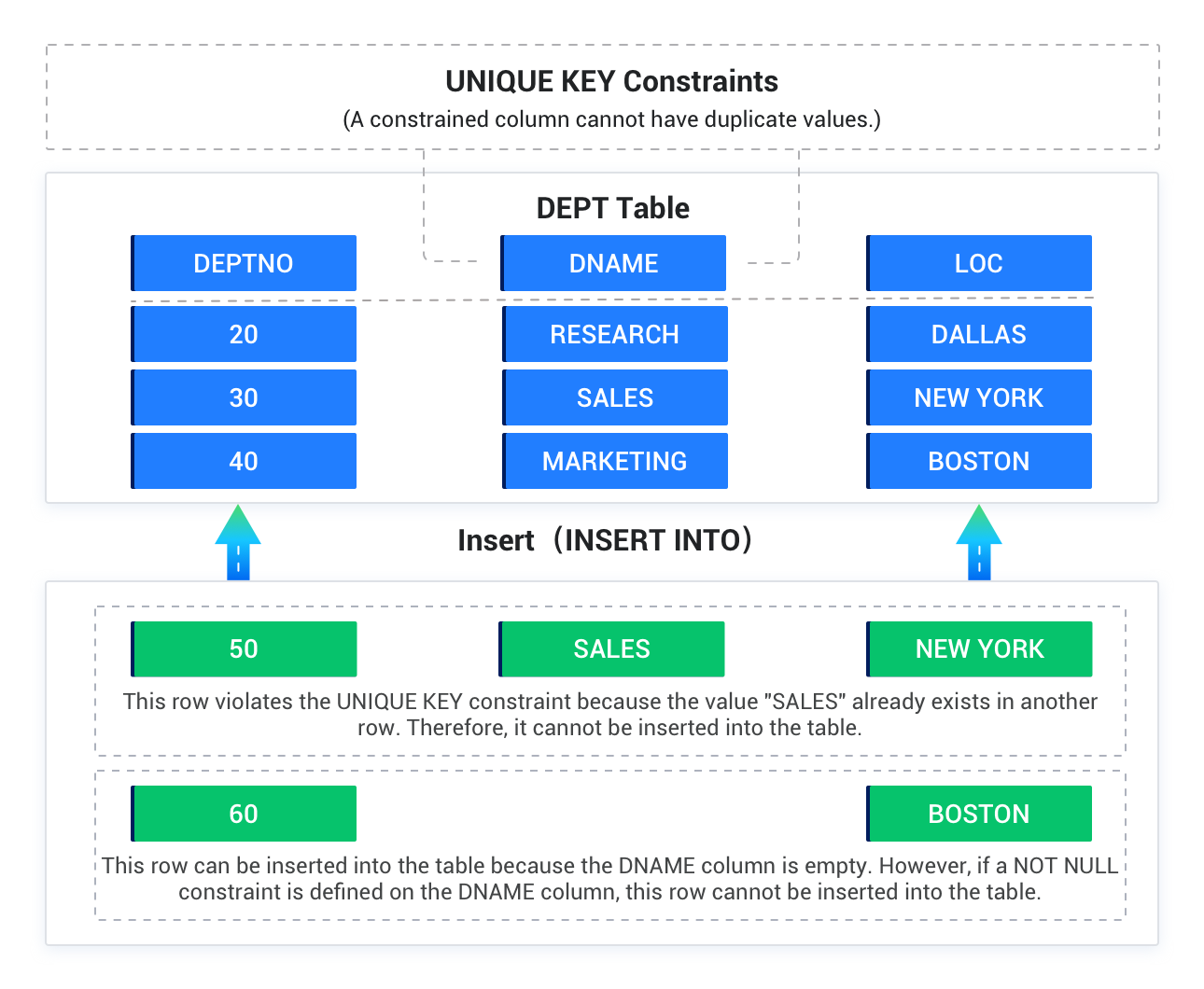
    In the following figure, a UNIQUE KEY constraint is defined on the DNAME column of the DEPT table. In this case, duplicate department names are not allowed in this table, but you can insert null values into the DNAME column. If a NOT NULL constraint is also defined on the DNAME column, you cannot insert null values into the DNAME column.
    Unique constraint

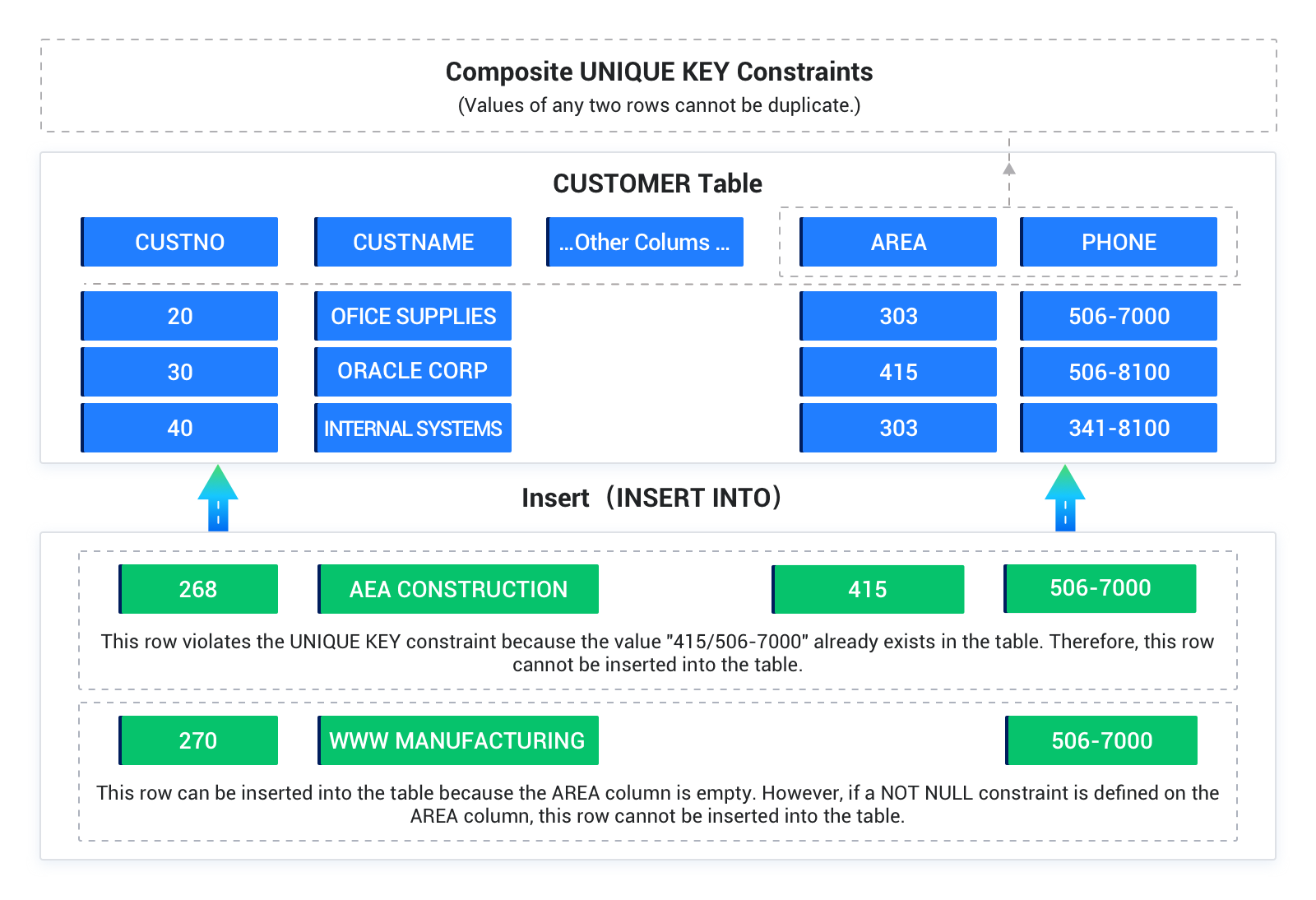
    If a UNIQUE KEY consists of multiple columns, this set of columns is referred to as a composite unique key. In the example shown below, the UNIQUE KEY constraint defined on the CUSTOMER table uses a composite unique key, consisting of the AREA and PHONE columns. This requires that the values of the key in any two rows cannot be duplicate. You can input null values in these columns. However, if the columns are also defined with a NOT NULL constraint, null values are not allowed.

    You can insert any number of records into the CUSTOMER table. However, according to the constraints imposed by UNIQUE KEY, the combination of area code and telephone number in each row must be unique. This helps to prevent issues with duplicate phone numbers caused by oversight.
    Unique constraint 2

    ​

    Previous topic

    NOT NULL constraints
    Last

    Next topic

    PRIMARY KEY constraints
    Next