Meet OceanBase AI Lakebase, the unified database for operational data, real-time analytics, and AI.
Meet OceanBase AI Lakebase, the unified database for operational data, real-time analytics, and AI. Explore ->
What FinTech Infrastructure Demands in the AI Era
- What fintech needs: A unified database foundation that solves for real-time, security, multimodel data, and internet-level scalability — not more layers.
- What AI changes: Autonomous agents demand hybrid search, ACID consistency, and controlled access in one place. The future of fintech competition is data infrastructure capability.
- The bigger shift: A unified data foundation is becoming a defining trait of AI-native systems — and structurally agent-friendly, because agents are economic actors that can't afford the token and latency cost of fragmentation.
OceanBase has been working alongside leading fintech enterprises across multiple countries and regions for years — including Alipay, DANA, GCash, TNG Digital, and 2C2P. Today, more than 100 fintech companies run on OceanBase, collectively serving over 1.3 billion end users. Across the broader financial sector — including 400+ financial organizations, with 60% deploying OceanBase in mission-critical systems — the pattern is consistent: high-concurrency transaction processing, elastic scalability under unpredictable load, and the kind of resilience that financial services demand with zero tolerance for data loss.
What these deployments share is not just a technology choice, but a common set of problems: how to maintain sub-second transaction latency at massive scale, how to ensure zero data loss across distributed infrastructure, and how to keep operational complexity manageable as the business grows.
The outside world may not have heard OceanBase speak systematically about fintech before. But the practice has been deep, sustained, and ongoing. The insights in this article come directly from that experience.
What FinTech Needs from Its Database
Working alongside these customers, one question keeps surfacing: what does fintech actually need from its database? Distilled from production, the answer is a unified, distributed foundation — not another specialized layer, not another pipeline — that handles high-concurrency transactions, elastic scaling, and extreme availability in one place.
Four forces make this urgent:
- Real-time is no longer optional. Payments, fraud checks, and credit decisions happen in milliseconds. Moving data between transactional and analytical systems before deciding is already too slow — stale data means wrong decisions.
- Security risk scales with complexity. Every extra system is another copy of sensitive data, another API, another pipeline. The more fragmented the stack, the larger the attack surface.
- Multimodel data is everywhere. Rows, documents, vectors, JSON, full-text compliance records — when they live in separate systems, both real-time insights and AI get harder.
- Scalability must be invisible. Fintech traffic is unpredictable. The database must scale out and scale down online, rebalancing across IDCs and cloud regions without application changes or downtime. Otherwise it's not scaling — it's a project.
The real challenge is all four hitting at once. The instinct to add more — a cache, a vector DB, an analytics engine — only compounds it. The shift we see is the opposite: consolidation into one foundation that is real-time, secure, multi-model, and elastic by default.
| Concern | Fragmented Stack | Unified Foundation |
| Real-time | Data moves between systems before decisions are made; sync lag introduces staleness | Queries run directly on live transactional data — no ETL, no replication delay |
| Multimodel | Relational, vector, and text data in separate systems; agents must query multiple endpoints | Relational, vector, full-text, and JSON data coexist in one engine; one query path |
| Security | Sensitive data copied across databases, pipelines, and AI tools; each copy is a risk | Data stays in one place; access controls, masking, and auditing enforced centrally |
| Scalability | Manual sharding, migration windows, application-level routing; scaling down is rarely supported | Auto data rebalance across IDC and cloud regions; scale out and scale down online, application-unaware |
| Operational cost | N systems to monitor, patch, scale, and staff | One system to operate |
AI Raises the Bar
With AI entering the picture, these four requirements don't disappear — they intensify. And a new class of challenges emerges on top of them.
Agents Are the New Data Consumers
AI agents are becoming the primary consumers of the database — not dashboards, not batch reports. Across our customer base, three access patterns keep showing up.
- Pattern 1: Many databases, small per-database volume. LingGuang's Wishing Coding Agent, the next-gen agent framework from Ant Group, spins up 25M Lite Apps, each a tiny tenant. Fintech mirrors this as per-advisor workspaces, SME-specific credit engines, and merchant-level risk models — millions of logically isolated databases with modest individual footprints. The requirement: a logical-DB abstraction that scales 0→∞ at ultra-low cost; hot-cold separation with on-demand loading and instant activation so idle tenants cost near zero; and logical isolation with independent indexes per database for full-throttle performance when any one tenant wakes up.
- Pattern 2: Multimodal data with inherent relevance. Taobao's Universal Search Agent fuses a Memory layer (chat history, item info, user profile) with a RAG layer over the same multimodal store, feeding one LLM. In fintech, the same pattern drives robo-advisors cross-validating research against NAVs and regulatory constraints, and fraud agents correlating transactions, device fingerprints, and behavioral history in a single decision. The requirement: multimodal storage holding structured profiles and unstructured chat logs side by side as memory; hybrid search — full-text + scalar + vector — across both memory and RAG in one query; and an all-in-one RAG + memory + database, not three systems stitched together.
- Pattern 3: Parallel, trial-and-error workflows. The AQ Agent Harness branches production into dev / test / staging / feature-branch-v2.1 so agents can experiment in parallel without touching the source of truth. In financial services this is backtesting, regulatory simulation, and fraud-rule iteration — each experiment needing its own isolated snapshot. The requirement: zero-cost branching via copy-on-write; fully independent, isolated branches created in milliseconds; database management that looks like a Git-style workflow rather than a migration project.
The common thread: agents consume factual, procedural, and contextual data simultaneously — at massive tenancy, mixed modalities, and constant branching. The question is no longer whether data can be queried, but whether the database can keep up with how agents actually use it.
Unified Data Foundation Is an AI-Native Trait
Across my recent conversations with fintech leaders, one view keeps landing: in the AI era, a unified data foundation isn't just "good architecture" — it's a defining trait of AI-native systems, on par with retrieval-first workflows or agentic orchestration. Teams increasingly want to focus upward, at the application and agent layer, and they accept — even prefer — a unified substrate below, because it makes everything above easier to build, run, and evolve.
For agents, this matters a level deeper than "zero-config" or natural-language SQL. Agents are economic actors: they pursue task completion in the fastest, cheapest, most token-efficient way. Fragmented data is structurally hostile to that — every extra system means more tool calls, more schemas to reconcile, more context tokens burned stitching results together, more failure modes to recover from. Historical technical preferences and siloed stores become dead weight on an agent's cost and latency budget. A unified foundation isn't only developer-friendly — it's architecturally agent-friendly, and that belongs in the same conversation as any other AI-native capability.
That doesn't mean rewriting everything. Unifying legacy systems rarely pencils out, and legacy and new stacks will coexist for a long time. The pragmatic path: adopt a unified architecture for all new infrastructure, and unify at the Data Agent layer so agents see a single, coherent surface even when the systems underneath are still mixed. New workloads get the benefits natively; existing ones are bridged, not forced.
Security Becomes the Most Sensitive Question
Security deserves particular attention because AI fundamentally changes the threat model.
- Should data go to LLMs for training? Most fintechs are clear: sensitive data should not leave your control. Instead of sending data out, the trend is to bring AI closer to where the data lives — so you decide what is accessed, what is masked, and what is never exposed.
- How do you prevent data leakage? Leakage usually happens because data is moving across too many systems — pipelines, APIs, tools. The more movement, the higher the risk. The focus now is to minimize data movement and keep everything within a controlled environment.
- What access should agents have? AI agents are powerful, but they should only get limited, role-based access with full visibility on what they're doing. No unrestricted access. Every action auditable.
The takeaway is simple: security in the AI era is about control. Keep data in one place, reduce movement, and give AI only the access it truly needs.
How OceanBase Delivers This
Rather than patching AI capabilities onto a legacy architecture, OceanBase is designed as a unified foundation — and every capability maps back to the challenges fintech teams actually face.
At a high level, OceanBase is a single stack from storage to the agent runtime:
- unified storage (low-cost, high-performance, resilient, multi-cloud, with native DB branching and multi-modal support) feeding a unified engine (OLTP + OLAP + multi-modal) that surfaces as both an HTAP database and a realtime multimodal lakebase,
- An AI-native layer on top — Agent Memory, RAG, OceanBase DataAgent (BI/ETL/governance), and a semantic network — accessible to traditional applications, lite apps, AI agents, and vibe-coded workloads through a single agent and CLI surface.
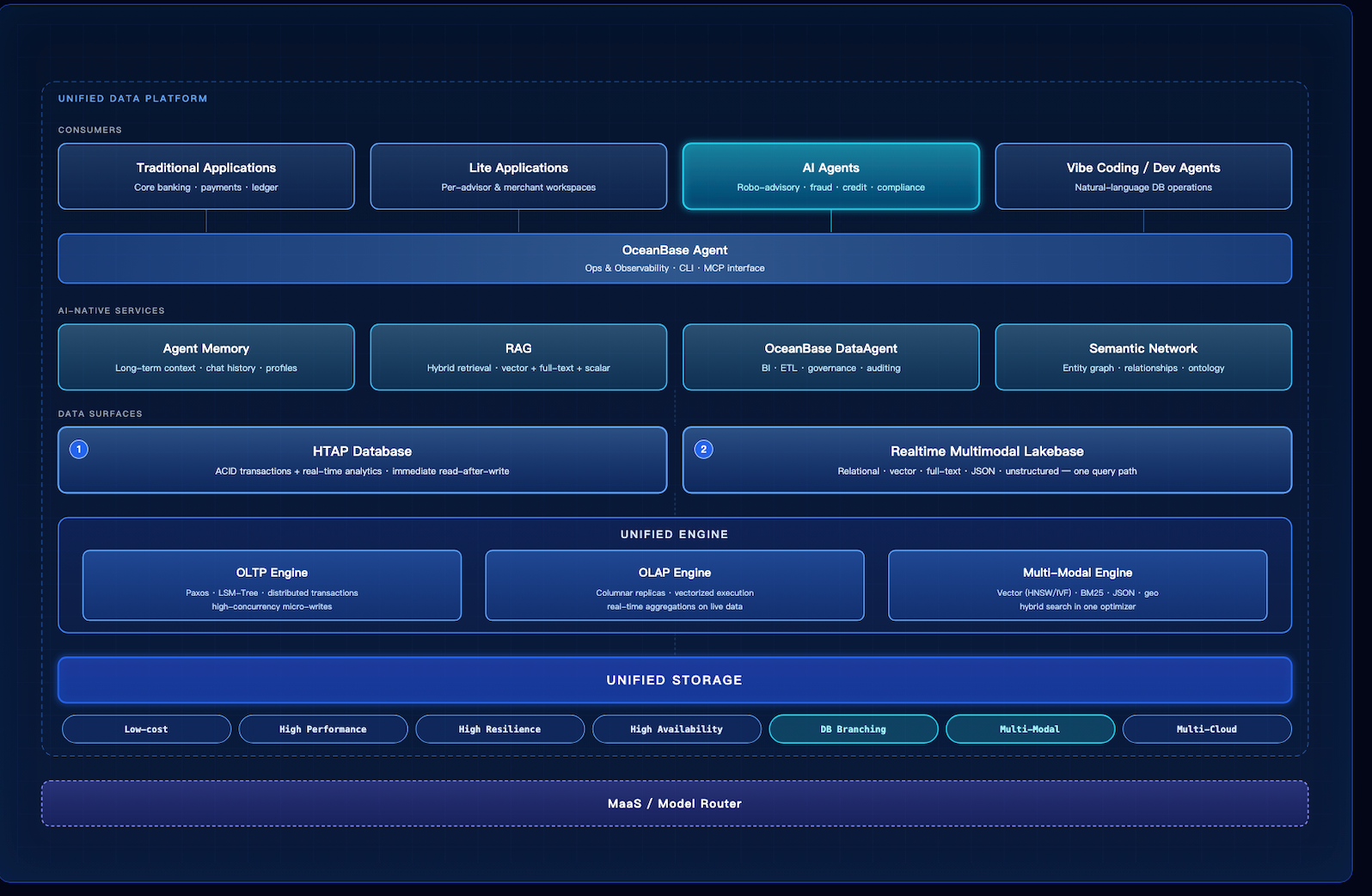
For fintech, this is what unification actually looks like: the same platform that processes AliPay's payment ledger now extends upward to power robo-advisors, fraud agents, credit engines, and regulatory simulation — without swapping databases, stitching a vector store onto the side, or rebuilding the security model at every layer. Every capability below is one layer of this stack, not a separate product.
Solving for Real-Time
OceanBase handles OLTP and real-time analytics in a single engine. Its hybrid row-column storage architecture routes queries dynamically — row-store for transactional workloads, column-store replicas for analytical queries — without requiring data to move between systems. A fraud detection agent can query live transaction data and run analytical aggregations in the same request, on the same platform.
For the high-frequency micro-write pattern that agents produce, OceanBase's LSM-Tree engine and distributed transaction architecture deliver full ACID guarantees with immediate read-after-write consistency. This is where OceanBase's OLTP heritage — forged in AliPay's payment processing — becomes a decisive advantage: agents are autonomous, and an agent that reads stale data after its own write can cascade errors across an entire workflow. This is what makes the fraud detection scenario viable — assembling a complete risk picture from live data within a 100ms decision window, not from a replica that's seconds behind.
Solving for Multimodel
Relational tables, vector embeddings, full-text search, and JSON data are all first-class citizens in the same engine — not extensions or plugins. Vector supports both dense and sparse types with HNSW and IVF indexes and multiple distance functions. Full-text uses BM25 inverted indexes. All index types are deeply integrated with the storage engine.
This makes hybrid search in a single query possible. OceanBase's query optimizer plans across vector similarity, BM25 keyword matching, and structured column filtering simultaneously, merging results through Reciprocal Rank Fusion (RRF) — with a unified cost model across all index types.
Taking this further, OceanBase wraps embedding generation, LLM inference, and result reranking as native SQL functions, allowing an agent to execute a full RAG pipeline in a single SQL call. The call chain collapses from six hops to one. For the robo-advisory agent, this means a single query can semantically search research reports, match domain terminology, and cross-validate against structured net asset values and risk ratings — all in one pass.
This is also what makes RAG and agent memory one system, not three. Structured user profiles, unstructured chat history, and vector-indexed knowledge all sit in the same store, so a single agent can pull long-term memory and retrieved context in the same query — no separate memory DB, no external vector store, no sync pipeline between them.
Solving for Security
When data lives in one place, security becomes simpler to enforce. OceanBase's native multi-tenancy provides resource isolation at the database level — each tenant gets its own resource allocation with cgroup-based physical isolation. Fine-grained access controls and audit capabilities mean organizations enforce data governance centrally. For AI-driven decisions like credit underwriting, this also provides the explainability foundation regulators require: every data point an agent accessed, every query it executed, and every permission boundary it operated within is traceable from a single audit log.
For AI-specific security, OceanBase's DataPilot — which currently ranks #1 on Adyen's DABstep financial reasoning leaderboard — exemplifies the principle of bringing AI to the data: AI capabilities operating directly on the data layer with proper permissions, masking, and auditing in place. No data leaves the controlled environment.
Solving for Scalability
OceanBase scales transparently — applications don't need to know. Data rebalances automatically across data centers and cloud regions as nodes are added or removed, with no migration windows and no application changes. Critically, OceanBase supports online scale-down just as smoothly as scale-out, so fintech teams can right-size infrastructure after traffic peaks without manual intervention. At production scale, single clusters run up to 1,000 nodes managing petabytes of data.
For the massive-tenancy pattern — per-advisor workspaces, SME-specific credit engines, merchant-level risk models — OceanBase provides a logical-database abstraction that scales from zero to millions of tenants at near-zero idle cost. Hot-cold separation keeps inactive tenants on cheap storage and loads them on demand with instant activation, while each logical DB carries its own indexes and isolation boundary so a single tenant waking up gets full-throttle performance, not noisy-neighbor latency.
Solving for Agent Workflows
Agents don't just query data — they fork it. Backtesting, regulatory simulation, and fraud-rule iteration all need isolated snapshots that diverge from production without copying terabytes or locking the source of truth. OceanBase supports copy-on-write branching: fully independent, read-write branches created in milliseconds, with zero storage cost until they diverge. Teams can spin up dev, staging, or feature-branch-v2.1 on live data, run an agent experiment end-to-end, and merge or discard — database operations that look like a Git workflow rather than a migration project.
Always Available, Battle-Tested
Underlying all of this is reliability proven at the scale of AliPay's payment processing, banking ledgers, and insurance platforms. Paxos-based multi-replica consensus delivers RPO=0 and RTO under 30 seconds. This isn't a feature added for fintech — it's the foundation the entire system was built on.
Looking Ahead
Walking alongside fintech customers over these years, what we see is not just technology architecture evolving. It's the fintech industry's relentless pursuit of stability, efficiency, resilience, and speed of innovation — all at once.
The future of fintech competition will not be defined by business models alone. It will increasingly be defined by data infrastructure capability. The organizations that can move fastest — deploying new AI-driven services, meeting new regulatory requirements, entering new markets — will be the ones whose data foundation doesn't hold them back.
A truly future-ready database must support today's core transaction systems and tomorrow's AI-driven financial services simultaneously. Not as separate layers bolted together, but as a single, unified platform.
That's the direction OceanBase has been building toward — and the direction we see working best for modern fintech.
Get Started
- Explore OceanBase: Visit oceanbase.com to learn about the unified distributed SQL architecture.
- See it in action: Read how fintechs are consolidating onto OceanBase to build resilient, cost-efficient foundations.
- Try OceanBase: Spin up a cluster on OceanBase Cloud and test multimodel queries — relational, vector, and full-text — in a single engine.


Keep Reading
View all posts
The Future of Relational Databases
Yang Zhenkun, OceanBase founder and chief scientist, made a keynote speech at HICOOL Global Entrepreneurs Summit. Dr. Yang talked about the milestones of the world’s mainstream relational databases and shared his visions on the future of distributed databases. When Dr. E. F. Codd, an IBM researcher,...

OceanBase AI Lakebase: Built on a Lakebase Architecture for the AI Era
OceanBase Lakebase unifies multi-modal data, transactions, analytics, and AI search in one engine for the agent era.


Data Matters
Fifteen years ago, OceanBase had just been born and proven its amazing ability during the 11.11 Global Shopping Festival. In those days, we spent every waking moment researching emerging technologies and envisioning an exciting new future. Then, a particular quote left a deep impression on me. Marc ...