

OceanBase logo

OceanBase

A unified distributed database ready for your transactional, analytical, and AI workloads.

Product Overview
DEPLOY YOUR WAY

OceanBase Cloud

The best way to deploy and scale OceanBase

OceanBase Enterprise

Run and manage OceanBase on your infra

TRY OPEN SOURCE

OceanBase Community Edition

The free, open-source distributed database

OceanBase seekdb

Open source AI native search database

Customer Stories

Real-world success stories from enterprises across diverse industries.

View All
BY USE CASES

Mission-Critical Transactions

Global & Multicloud Application

Elastic Scaling for Peak Traffic

Real-time Analytics

Active Geo-redundancy

Database Consolidation

Resources

Comprehensive knowledge hub for OceanBase.

Blog

Live Demos

Training & Certification

Documentation

Official technical guides, tutorials, API references, and manuals for all OceanBase products.

View All
PRODUCTS

OceanBase Cloud

OceanBase Database

Tools

Connectors and Middleware

QUICK START

OceanBase Cloud

OceanBase Database

BEST PRACTICES

Practical guides for utilizing OceanBase more effectively and conveniently

Company

Learn more about OceanBase – our company, partnerships, and trust and security initiatives.

About OceanBase

Partner

Trust Center

Contact Us

International - English
中国站 - 简体中文
日本 - 日本語
Sign In
Start on Cloud

OceanBase

A unified distributed database ready for your transactional, analytical, and AI workloads.

Product Overview
DEPLOY YOUR WAY

OceanBase Cloud

The best way to deploy and scale OceanBase

OceanBase Enterprise

Run and manage OceanBase on your infra

TRY OPEN SOURCE

OceanBase Community Edition

The free, open-source distributed database

OceanBase seekdb

Open source AI native search database

Customer Stories

Real-world success stories from enterprises across diverse industries.

View All
BY USE CASES

Mission-Critical Transactions

Global & Multicloud Application

Elastic Scaling for Peak Traffic

Real-time Analytics

Active Geo-redundancy

Database Consolidation

Comprehensive knowledge hub for OceanBase.

Blog

Live Demos

Training & Certification

Documentation

Official technical guides, tutorials, API references, and manuals for all OceanBase products.

View All
PRODUCTS
OceanBase CloudOceanBase Database
ToolsConnectors and Middleware
QUICK START
OceanBase CloudOceanBase Database
BEST PRACTICES

Practical guides for utilizing OceanBase more effectively and conveniently

Learn more about OceanBase – our company, partnerships, and trust and security initiatives.

About OceanBase

Partner

Trust Center

Contact Us

Start on Cloud
编组
All Products
    • Databases
    • iconOceanBase Database
    • iconOceanBase Cloud
    • iconOceanBase Tugraph
    • iconInteractive Tutorials
    • iconOceanBase Best Practices
    • Tools
    • iconOceanBase Cloud Platform
    • iconOceanBase Migration Service
    • iconOceanBase Developer Center
    • iconOceanBase Migration Assessment
    • iconOceanBase Admin Tool
    • iconOceanBase Loader and Dumper
    • iconOceanBase Deployer
    • iconKubernetes operator for OceanBase
    • iconOceanBase Diagnostic Tool
    • iconOceanBase Binlog Service
    • Connectors and Middleware
    • iconOceanBase Database Proxy
    • iconEmbedded SQL in C for OceanBase
    • iconOceanBase Call Interface
    • iconOceanBase Connector/C
    • iconOceanBase Connector/J
    • iconOceanBase Connector/ODBC
    • iconOceanBase Connector/NET
icon

OceanBase Database Proxy

V3.1.0Enterprise Edition

  • About ODP
    • What is OceanBase Database Proxy?
    • Glossary
  • Installation and Deployment
    • Preparation
    • Install ODP by using RPM packages
    • Manage OBProxies
      • Create an OBProxy cluster
      • Take over an OBProxy
      • Delete an OBProxy
      • Restart an OBProxy
      • Upgrade an OBProxy
      • Add an OBProxy
      • Refresh OBProxy configurations
      • Monitor OBProxy cluster performance
      • OBProxy cluster parameter management
      • Add a connectable OceanBase cluster
      • Delete an OBProxy cluster
      • Upgrade all OBProxies in an OBProxy cluster
      • Restart all OBProxies in an OBProxy cluster
      • Delete a connected OceanBase cluster
  • User Guide
    • Configuration
      • Obtain and modify configurations
      • Parameters
      • Dynamically modifiable parameters
      • Parameters that are not dynamically modifiable
      • Internal and inherited parameters
      • In-memory parameters
    • SQL statement routing
      • Create and update the RootService list
      • Create and update the location cache

Download PDF

What is OceanBase Database Proxy? Glossary Preparation Install ODP by using RPM packages Create an OBProxy cluster Take over an OBProxy Delete an OBProxy Restart an OBProxy Upgrade an OBProxy Add an OBProxy Refresh OBProxy configurations Monitor OBProxy cluster performance OBProxy cluster parameter management Add a connectable OceanBase cluster Delete an OBProxy cluster Upgrade all OBProxies in an OBProxy cluster Restart all OBProxies in an OBProxy cluster Delete a connected OceanBase cluster Obtain and modify configurations Parameters Dynamically modifiable parameters Parameters that are not dynamically modifiable Internal and inherited parameters In-memory parameters Create and update the RootService list Create and update the location cache
OceanBase logo

The Unified Distributed Database for the AI Era.

Follow Us
Products
OceanBase CloudOceanBase EnterpriseOceanBase Community EditionOceanBase seekdb
Resources
DocsBlogLive DemosTraining & CertificationTicket
Company
About OceanBaseTrust CenterLegalPartnerContact Us
Follow Us

© OceanBase 2026. All rights reserved

Cloud Service AgreementPrivacy PolicySecurity
Contact Us
Document Feedback
  1. Documentation Center
  2. OceanBase Database Proxy
  3. V3.1.0
iconOceanBase Database Proxy
V 3.1.0Enterprise Edition
Databases
  • OceanBase Database
  • OceanBase Cloud
  • OceanBase Tugraph
  • Interactive Tutorials
  • OceanBase Best Practices
Tools
  • OceanBase Cloud Platform
  • OceanBase Migration Service
  • OceanBase Developer Center
  • OceanBase Migration Assessment
  • OceanBase Admin Tool
  • OceanBase Loader and Dumper
  • OceanBase Deployer
  • Kubernetes operator for OceanBase
  • OceanBase Diagnostic Tool
  • OceanBase Binlog Service
Connectors and Middleware
  • OceanBase Database Proxy
  • Embedded SQL in C for OceanBase
  • OceanBase Call Interface
  • OceanBase Connector/C
  • OceanBase Connector/J
  • OceanBase Connector/ODBC
  • OceanBase Connector/NET
  • V 4.3.6
  • V 4.3.4
  • V 4.3.3
  • V 4.3.2
  • V 4.3.1
  • V 4.3.0
  • V 4.2.3
  • V 4.2.2
  • V 4.2.0 and earlier

Take over an OBProxy

Last Updated:2026-04-14 01:41:29  Updated
Share
What is on this page
Prerequisites
Procedure

folded

Share

This topic describes how to use the OBProxy cluster managed by the current OCP cluster to take over an OBProxy created by another OCP cluster. The OBProxy cluster that is created by another OCP cluster is called the to-be-taken-over OBProxy. The OBProxy cluster that is about to take over the to-be-taken-over OBProxy is called the target OBProxy cluster. After the candidate is taken over by the target, you can operate and maintain them both in the current OCP cluster.

Prerequisites

  • You have the OBPROXY_MANAGER role or permissions to manage OBProxy.

  • The to-be-taken-over OBProxy cluster must meet the following conditions:

    • Its version is V1.8.0 or later.

    • It is installed by using the standard RPM package, and the installation path is /opt/taobao/install/obproxy-{version}.

    • The OBProxy host has only one obproxy process, and the process belongs to the administrator.

    • It is accessible in the network where the OCP cluster resides.

    • The OBProxy host has been added to the OCP cluster. For more information, see Add a host.

  • The to-be-taken-over proxy and the target OBProxy cluster must match in the following aspects:

    • The startup method.

      For example, if the target OBProxy cluster starts in ConfigUrl mode, the to-be-taken-over OBProxy must also starts in ConfigUrl mode.

    • In ConfigUrl mode, the connectable OceanBase clusters of the to-be-taken-over OBProxy cluster are among those for the target OBProxy cluster.

    • In RsList mode, the to-be-taken-over OBProxy and the target OBProxy cluster must share exactly the same connectable OceanBase clusters.

Procedure

  1. Log on to the OCP console.

  2. In the left-side navigation pane, click OBProxy to go to the OBProxy page.

  3. Go to the Take over OBProxy page.

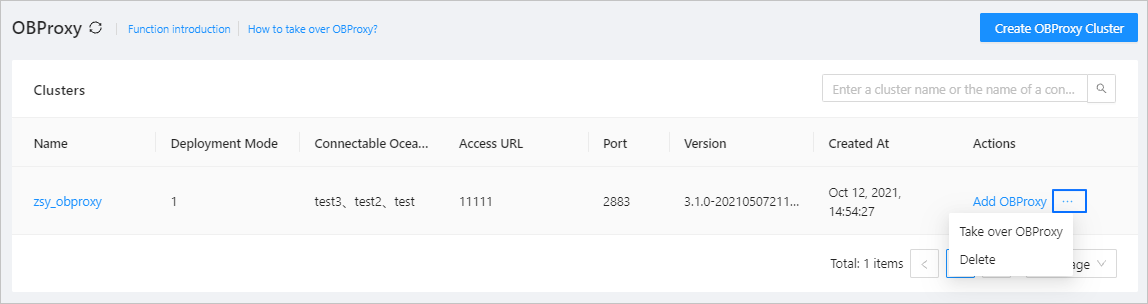
    • Path 1: In the Clusters list, find an eligible target cluster that can take the to-be-taken-over OBProxy, and then click Take over OBProxy in the Actions column.
      10291407

    • Path 2:

      1. In the Clusters list, find an eligible target cluster that can take over the to-be-taken-over OBProxy, and then click the cluster name to go to the Overview page of the target OBProxy cluster.

      2. Click Take over OBProxy in the upper-right corner of the Overview page.

        10291408

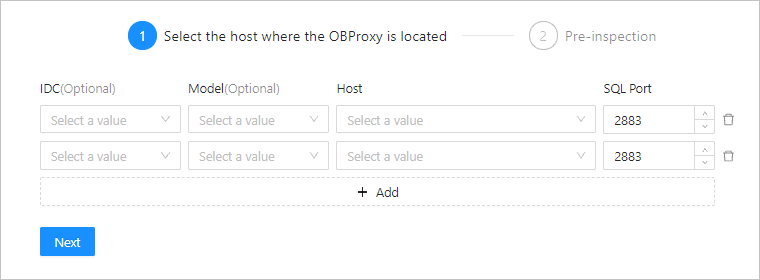
  4. In the Take over OBProxy page that appears, select the host where the to-be-taken-over OBProxy is deployed.
    10291409

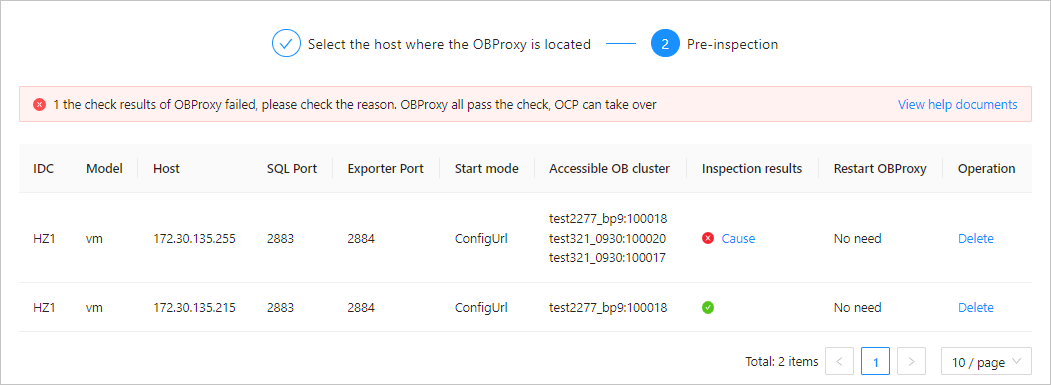
  5. Click Next . The system checks the to-be-taken-over OBProxies and displays the result on the pre-check page.
    1130

    If the check fails, the takeover cannot proceed. In this case, perform the following steps:

    • Remove the OBProxy that fails the check based on the actual situation and take over only the OBProxy that passes the pre-check.

    • Move the pointer over the cause icon in the Inspection results column to view the cause of the check failure.

      After you fix the problem, click Recheck .

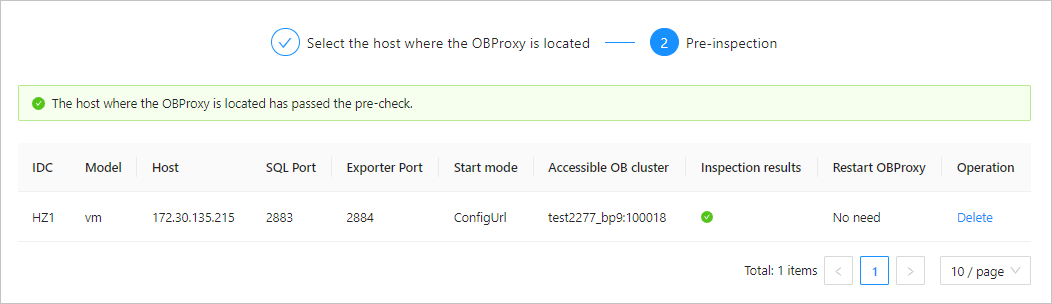
    When all OBProxies in the list pass the pre-check, proceed to Step 6.
    113002

  6. Click Take over All .

    Wait for the takeover task to complete.

Previous topic

Create an OBProxy cluster
Last

Next topic

Delete an OBProxy
Next
What is on this page
Prerequisites
Procedure