

OceanBase logo

OceanBase

A unified distributed database ready for your transactional, analytical, and AI workloads.

DEPLOY YOUR WAY

OceanBase Cloud

The best way to deploy and scale OceanBase

OceanBase Enterprise

Run and manage OceanBase on your infra

TRY OPEN SOURCE

OceanBase Community Edition

The free, open-source distributed database

OceanBase seekdb

Open source AI native search database

Customer Stories

Real-world success stories from enterprises across diverse industries.

View All
BY USE CASES

Mission-Critical Transactions

Global & Multicloud Application

Elastic Scaling for Peak Traffic

Real-time Analytics

Active Geo-redundancy

Database Consolidation

Resources

Comprehensive knowledge hub for OceanBase.

Blog

Live Demos

Training & Certification

Documentation

Official technical guides, tutorials, API references, and manuals for all OceanBase products.

View All
PRODUCTS

OceanBase Cloud

OceanBase Database

Tools

Connectors and Middleware

QUICK START

OceanBase Cloud

OceanBase Database

BEST PRACTICES

Practical guides for utilizing OceanBase more effectively and conveniently

Company

Learn more about OceanBase – our company, partnerships, and trust and security initiatives.

About OceanBase

Partner

Trust Center

Contact Us

International - English
中国站 - 简体中文
日本 - 日本語
Sign In
Start on Cloud

A unified distributed database ready for your transactional, analytical, and AI workloads.

DEPLOY YOUR WAY

OceanBase Cloud

The best way to deploy and scale OceanBase

OceanBase Enterprise

Run and manage OceanBase on your infra

TRY OPEN SOURCE

OceanBase Community Edition

The free, open-source distributed database

OceanBase seekdb

Open source AI native search database

Customer Stories

Real-world success stories from enterprises across diverse industries.

View All
BY USE CASES

Mission-Critical Transactions

Global & Multicloud Application

Elastic Scaling for Peak Traffic

Real-time Analytics

Active Geo-redundancy

Database Consolidation

Comprehensive knowledge hub for OceanBase.

Blog

Live Demos

Training & Certification

Documentation

Official technical guides, tutorials, API references, and manuals for all OceanBase products.

View All
PRODUCTS
OceanBase CloudOceanBase Database
ToolsConnectors and Middleware
QUICK START
OceanBase CloudOceanBase Database
BEST PRACTICES

Practical guides for utilizing OceanBase more effectively and conveniently

Learn more about OceanBase – our company, partnerships, and trust and security initiatives.

About OceanBase

Partner

Trust Center

Contact Us

Start on Cloud
编组
All Products
    • Databases
    • iconOceanBase Database
    • iconOceanBase Cloud
    • iconOceanBase Tugraph
    • iconInteractive Tutorials
    • iconOceanBase Best Practices
    • Tools
    • iconOceanBase Cloud Platform
    • iconOceanBase Migration Service
    • iconOceanBase Developer Center
    • iconOceanBase Migration Assessment
    • iconOceanBase Admin Tool
    • iconOceanBase Loader and Dumper
    • iconOceanBase Deployer
    • iconKubernetes operator for OceanBase
    • iconOceanBase Diagnostic Tool
    • iconOceanBase Binlog Service
    • Connectors and Middleware
    • iconOceanBase Database Proxy
    • iconEmbedded SQL in C for OceanBase
    • iconOceanBase Call Interface
    • iconOceanBase Connector/C
    • iconOceanBase Connector/J
    • iconOceanBase Connector/ODBC
    • iconOceanBase Connector/NET
icon

OceanBase Developer Center

V4.1.3Enterprise Edition

  • Document Overview
  • Overview
    • What is ODC?
    • Benefits
    • Architecture
    • Features
    • Limits
  • Quick Start
    • Overview
    • Install ODC
    • Log on to ODC with an account
    • Create a private connection
  • Tutorials
    • Tips on the SQL Console
    • Create a connection
    • Export data
    • Import data
    • Debug a stored procedure
    • View the performance of an SQL statement
  • User Guide (Web ODC)
    • Log on to ODC
      • Log on to ODC with an account
      • Change the password
    • ODC homepage
    • Connect to a database
      • Create a private connection
      • Manage private connections
    • Public resource management
      • Overview
      • Quick start
      • Resource permissions
        • Manage public connections
        • Manage resource groups
        • Manage roles
        • Manage users
        • Automatic authorization rules
      • Task process management
      • Manage operation records
      • Data desensitization management
      • System settings
    • Use the workspace
      • Overview
      • SQL window
      • Anonymous block window
      • Command-line window
      • Stored scripts
      • Snippet
    • Use tools
      • Data export and import
        • Overview
        • Export and import formats
        • Batch export and import
        • Single table export and import
      • Data mocking
      • Partitioning plan
      • Database changes
      • Shadow table synchronization
      • SQL plan
    • Recycle bin
    • View operation records
    • Task management
      • Overview
      • Import tasks
      • Export tasks
      • Data mocking tasks
      • Database change tasks
      • Partitioning plan task
      • Permission application tasks
      • Shadow table synchronization tasks
      • SQL plan task
    • Session management
    • Database objects
      • Table objects
        • Overview
        • Create a table
        • Table list
        • Manage table attributes
        • Manage table data
      • View objects
        • Overview
        • Create a view
        • Manage views
      • Function objects
        • Overview
        • Create a function
        • Manage functions
      • Stored procedure objects
        • Overview
        • Create a stored procedure
        • Manage stored procedures
      • Sequence objects
        • Overview
        • Create a sequence
        • Manage sequences
      • Package objects
        • Overview
        • Create a program package
        • Manage program packages
      • Trigger objects
        • Overview
        • Create a trigger
        • Manage triggers
      • Type objects
        • Overview
        • Create a type
        • Manage types
      • Synonym objects
        • Overview
        • Create a synonym
        • Manage synonyms
    • Help center
  • User Guide (Client ODC)
    • Install ODC
    • ODC homepage
    • Connect to a database
      • Create a private connection
      • Manage connections
    • Use the workspace
      • Overview
      • SQL window
      • Anonymous block window
      • Command-line window
      • Stored scripts
      • Snippet
    • Use tools
      • Data export and import
        • Overview
        • Export and import formats
        • Batch export and import
        • Single table export and import
      • Data mocking
      • Asynchronous execution
      • Shadow table synchronization
    • Recycle bin
    • View operation records
    • Task management
      • Overview
      • Import tasks
      • Export tasks
      • Data mocking tasks
      • Database Change
      • Shadow table synchronization tasks
    • Session management
    • Database objects
      • Table objects
        • Overview
        • Create a table
        • Table list
        • Manage table attributes
        • Manage table data
      • View objects
        • Overview
        • Create a view
        • Manage views
      • Function objects
        • Overview
        • Create a function
        • Manage functions
      • Stored procedure objects
        • Overview
        • Create a stored procedure
        • Manage stored procedures
      • Sequence objects
        • Overview
        • Create a sequence
        • Manage sequences
      • Package objects
        • Overview
        • Create a program package
        • Manage program packages
      • Trigger objects
        • Overview
        • Create a trigger
        • Manage triggers
      • Type objects
        • Overview
        • Create a type
        • Manage types
      • Synonym objects
        • Overview
        • Create a synonym
        • Manage synonyms
    • Help center
  • Deployment Guide
    • Deployment overview
    • Preparations before deployment
    • Deploy a single ODC node
      • Deployment process
      • Load and run an ODC image
    • Deploy ODC in high availability mode
      • Deployment process
      • Load and run an ODC image
      • Deploy SSL certificate
      • Deploy the NGINX proxy
      • Configure certificate trust
    • Deployment verification
  • Upgrade Guide
    • Overview
    • Preparations before upgrade
    • Upgrade single-node ODC
      • Upgrade process
      • Stop ODC of the earlier version
      • Load and run an ODC image
    • Upgrade high-availability
      • Upgrade process
      • Stop ODC of the earlier version
      • Load and run an ODC image
      • Upgrade NGINX image
    • Upgrade verification
    • Rollback after upgrade failed
  • FAQ
  • Release Note
    • V4.1
      • ODC V4.1.3
      • ODC V4.1.1
      • ODC V4.1.2
      • ODC V4.1.0
    • V4.0
      • ODC V4.0.2
      • ODC V4.0.0
    • V3.4
      • ODC V3.4.0
    • V3.3
      • ODC V3.3.3
      • ODC V3.3.2
      • ODC V3.3.1
      • ODC V3.3.0
    • V3.2
      • ODC V3.2.3
      • ODC V3.2.2
      • ODC V3.2.1
      • ODC V3.2.0

Download PDF

Document Overview What is ODC? Benefits Architecture Features Limits Overview Install ODC Log on to ODC with an account Create a private connection Tips on the SQL Console Create a connection Export data Import data Debug a stored procedure View the performance of an SQL statement Log on to ODC with an account Change the password ODC homepageCreate a private connection Manage private connections Overview Quick start Task process managementManage operation records Data desensitization managementSystem settings Overview SQL windowAnonymous block window Command-line window Stored scripts Snippet Data mocking Partitioning planDatabase changes Shadow table synchronization SQL planRecycle bin View operation records Overview Import tasks Export tasksData mocking tasks Database change tasks Partitioning plan task Permission application tasks Shadow table synchronization tasks SQL plan taskSession management Help center Install ODC ODC homepage Create a private connection Manage connections Overview SQL windowAnonymous block window Command-line window Stored scripts Snippet Data mocking Asynchronous execution Shadow table synchronizationRecycle bin View operation records Overview Import tasksExport tasks Data mocking tasks Database Change Shadow table synchronization tasksSession management Help center Deployment overview Preparations before deployment Deployment process Load and run an ODC image Deployment process Load and run an ODC image Deploy SSL certificate Deploy the NGINX proxy Configure certificate trust Deployment verificationOverview Preparations before upgrade Upgrade process Stop ODC of the earlier version Load and run an ODC image Upgrade process Stop ODC of the earlier version Load and run an ODC image Upgrade NGINX image Upgrade verification Rollback after upgrade failed FAQ ODC V4.1.3 ODC V4.1.1 ODC V4.1.2 ODC V4.1.0
OceanBase logo

The Unified Distributed Database for the AI Era.

Follow Us
Products
OceanBase CloudOceanBase EnterpriseOceanBase Community EditionOceanBase seekdb
Resources
DocsBlogLive DemosTraining & Certification
Company
About OceanBaseTrust CenterLegalPartnerContact Us
Follow Us

© OceanBase 2026. All rights reserved

Cloud Service AgreementPrivacy PolicySecurity
Contact Us
Document Feedback
  1. Documentation Center
  2. OceanBase Developer Center
  3. V4.1.3
iconOceanBase Developer Center
V 4.1.3Enterprise Edition
  • V 4.4.2
  • V 4.4.1
  • V 4.4.0
  • V 4.3.4
  • V 4.3.3
  • V 4.3.2
  • V 4.3.1
  • V 4.3.0
  • V 4.2.4
  • V 4.2.3
  • V 4.2.2
  • V 4.2.1
  • V 4.2.0
  • V 4.1.3 and earlier
Community Edition
  • V 4.1.0
  • V 4.0.0
  • V 3.3.2
  • V 3.2.2
Enterprise Edition
  • V 4.1.3
  • V 3.4.0

Import tasks

Last Updated:2026-04-13 07:40:37  Updated
share
What is on this page
Task list
Create an import task
View an import task
Task information
Task logs

folded

share

After you create a batch or single table import task in OceanBase Developer Center (ODC), you can view the task in the task list on the Import tab of the Task Center panel.

Task list

Note

  • The task list displays the tasks in the last 48 hours.
  • ODC allows you to run up to three export tasks in parallel, while subsequent tasks wait in the queue.

ODC allows you to run up to three import tasks in parallel, while subsequent tasks wait in the queue.

On the management page of the database connection, click Task Center in the top navigation bar to open the Task Center panel. Click Import to display the list of import tasks.
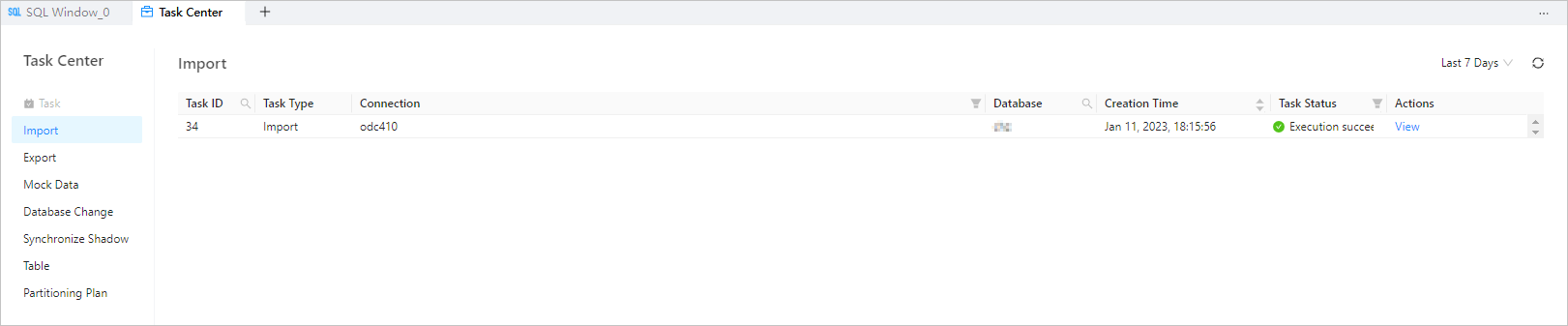
1

The following table describes the columns in the task list. You can filter and sort tasks by some of the columns.

Column Description
Task ID The ID of the import task.
Task Type The task type specified when the task was created. The following task types are supported: import, export, data mocking, and database change.
Connection The name of the database connection to which the task belongs. You can click the filter icon Filter to filter the tasks by connection.
Database The database to be changed. You can click the search icon Search to search for the database to which the task belongs.
Creator The user who created the import task. You can click the search icon Search to search for the creator.
Creation Time The date and time when the task was generated.
Task Status The current status of the task. ODC provides different management actions for tasks in different states.
Actions The actions you can take. Valid values: View , Approve/Reject , Abort , and Download . * View: Click this button to go to the task details page to view the task information and task logs. * Approve/Reject: Click this button to approve or reject a running task. * Abort: Click this button to abort a running task. * Download: Click this button to download the exported file to your local device when the task is complete.

Create an import task

  1. In the pop-up task center panel, click + on the right side of Import to pop up the new import task panel.

    1

  2. In the Create Import Task panel, Specify the import format.

    2

    As shown in the preceding figure, ODC supports batch import of CSV Files, SQL Files, and ZIP Files. You can select the desired file format from the Import Format drop-down list. For more information about formats, see Export and import formats.

    Note

    • If you select CSV Files for Import Format, you can skip the values of the column header in the first row.
    • If you select ZIP Files for Import Format, you can import single or multiple tables and skip existing structures.
  3. Upload the file to be imported

    Click the file pool to go to the file explorer and select the file to be imported. You can also directly drag the file to the file pool to upload it. The format of the uploaded file must be the same as that of the value you specified for Import Format. Upload files suffixed with .zip if you have selected ZIP Files for Import Format, upload files suffixed with .sql if you have selected SQL Files for Import Format, and upload files suffixed with .csv if you have selected CSV Files for Import Format.

  4. Specify the file encoding

    ODC supports the following encoding standards: ASCII, ISO-8859-1, GB2312, GBK, GB18030, Unicode (UTF-8), Unicode (UTF-16), Unicode (UTF-32), and BIG5. You can select the encoding standard from the File Encoding drop-down list.

  5. Go to the Import Settings panel

    Click Next: Import Settings to specify file import settings and the sys tenant account.

  6. Specify Import Content

    3

    You must specify this parameter when you select ZIP Files for Import Format. ODC supports Import Data Only, Import Schema Only, and Import Schema and Data. Import Schema Only imports the definition statements of the target object. You can select the import content from the Import Content drop-down list.

  7. Select a database

    Select the database to which the data object is to be imported. The name of the database connection to which the task belongs is also displayed.

  8. Specify Import Data Settings

    If you select ZIP Files for Import Format and Import Data Only or Import Schema and Data for Import Content, this option must be specified. You need to specify the following fields:

    • Clear Data Before Import: If you select this option, the original data in the destination object is cleared during data import.

    • Batch Commit Quantity: You can click Advanced next to Export Data Settings to specify this field. After you specify this field, a COMMIT statement is executed when the number of exported data rows reaches the specified quantity.

    • Skipped Data Type (Optional): You can specify the data types to be skipped during data import. The data types that can be skipped are different in MySQL and Oracle modes. You can select multiple data types.

  9. Specify Import Schema Settings

    You cannot specify this field if you select Import Data Only for Import Content. This field involves operations on schemas that already exist. If you select Skip, the system skips the schema definition statement in the file to be imported and directly imports the data. The original data in the object is retained. If you select Replace, the system executes the schema definition statement in the file to be imported to re-create an object and replace the original one. Data in the original object is cleared.

  10. Specify Task Error Handling Method and the execution method

  • ODC supports two error handling methods: Abort Task and Ignore Error and Continue. You need to select the handling method as required.

  • Select Execute immediately or Timed execution.

  1. Set up the sys tenant account

    • Choose whether to select Use sys Tenant Account to Accelerate Export Task. If you select this option, specify Account and Password.

    • After you specify the account and password, you can click the Test Connection button next to the password box to verify whether the account information is valid. By default, the account for the connection settings is automatically filled in. If the connection fails, we recommend that you change the password for this export.

      Notice

      • The account and password of the sys tenant are the account and password of a user in a cluster tenant. Do not enter @sys#cluster in the Account field. Example: account odc, password ******.
      • If the account of the sys tenant is not configured, indexes are not imported or exported.
  2. Retain Current Configuration

Check Retain Current Configuration to keep the current part of the data file and structure file configuration.

  1. Generate an import task

After you specify all preceding information, you can click Submit in the lower-right corner of the panel to create an import task.

View an import task

Task information

Click View in the Actions column of the row where the target task is located. The task details panel appears. Click Task Information in the upper-right corner of the panel to view the basic task information, information about the imported files, and information about the imported objects.

Item Description
Basic information Displays the basic information of the task, such as Task ID , Connection , Database , and Task Type .
Information about imported files Displays information that you specified when you created the import task, such as Import Format , Import File , Encoding Standard , Import Content , Data Format , Import Data Settings , Task Error Handling Method , Sys Tenant Account Settings , and CSV Settings ,
Information about imported objects Displays the information of imported objects and the progress of the import task, such as Object Name , Object Type , Planned Processing Quantity , Actual Processing Quantity , and Data Processing Status .

Task logs

Click View in the Actions column of the row where the target task is located. The task details panel appears. Click Task Logs in the upper-right corner of the panel to view the alert logs and all logs of the task.

Field Description
All Logs Displays the INFO , ERROR , and WARN logs of the task.
Alert Logs Displays the ERROR and WARN logs of the task. When a task fails, you can view the error message in the alert logs.

Previous topic

Overview
Last

Next topic

Export tasks
Next
What is on this page
Task list
Create an import task
View an import task
Task information
Task logs