

OceanBase logo

OceanBase

A unified distributed database ready for your transactional, analytical, and AI workloads.

Product Overview
DEPLOY YOUR WAY

OceanBase Cloud

The best way to deploy and scale OceanBase

OceanBase Enterprise

Run and manage OceanBase on your infra

TRY OPEN SOURCE

OceanBase Community Edition

The free, open-source distributed database

OceanBase seekdb

Open source AI native search database

Customer Stories

Real-world success stories from enterprises across diverse industries.

View All
BY USE CASES

Mission-Critical Transactions

Global & Multicloud Application

Elastic Scaling for Peak Traffic

Real-time Analytics

Active Geo-redundancy

Database Consolidation

Resources

Comprehensive knowledge hub for OceanBase.

Blog

Live Demos

Training & Certification

Documentation

Official technical guides, tutorials, API references, and manuals for all OceanBase products.

View All
PRODUCTS

OceanBase Cloud

OceanBase Database

Tools

Connectors and Middleware

QUICK START

OceanBase Cloud

OceanBase Database

BEST PRACTICES

Practical guides for utilizing OceanBase more effectively and conveniently

Company

Learn more about OceanBase – our company, partnerships, and trust and security initiatives.

About OceanBase

Partner

Trust Center

Contact Us

International - English
中国站 - 简体中文
日本 - 日本語
Sign In
Start on Cloud

OceanBase

A unified distributed database ready for your transactional, analytical, and AI workloads.

Product Overview
DEPLOY YOUR WAY

OceanBase Cloud

The best way to deploy and scale OceanBase

OceanBase Enterprise

Run and manage OceanBase on your infra

TRY OPEN SOURCE

OceanBase Community Edition

The free, open-source distributed database

OceanBase seekdb

Open source AI native search database

Customer Stories

Real-world success stories from enterprises across diverse industries.

View All
BY USE CASES

Mission-Critical Transactions

Global & Multicloud Application

Elastic Scaling for Peak Traffic

Real-time Analytics

Active Geo-redundancy

Database Consolidation

Comprehensive knowledge hub for OceanBase.

Blog

Live Demos

Training & Certification

Documentation

Official technical guides, tutorials, API references, and manuals for all OceanBase products.

View All
PRODUCTS
OceanBase CloudOceanBase Database
ToolsConnectors and Middleware
QUICK START
OceanBase CloudOceanBase Database
BEST PRACTICES

Practical guides for utilizing OceanBase more effectively and conveniently

Learn more about OceanBase – our company, partnerships, and trust and security initiatives.

About OceanBase

Partner

Trust Center

Contact Us

Start on Cloud
编组
All Products
    • Databases
    • iconOceanBase Database
    • iconOceanBase Cloud
    • iconOceanBase Tugraph
    • iconInteractive Tutorials
    • iconOceanBase Best Practices
    • Tools
    • iconOceanBase Cloud Platform
    • iconOceanBase Migration Service
    • iconOceanBase Developer Center
    • iconOceanBase Migration Assessment
    • iconOceanBase Admin Tool
    • iconOceanBase Loader and Dumper
    • iconOceanBase Deployer
    • iconKubernetes operator for OceanBase
    • iconOceanBase Diagnostic Tool
    • iconOceanBase Binlog Service
    • Connectors and Middleware
    • iconOceanBase Database Proxy
    • iconEmbedded SQL in C for OceanBase
    • iconOceanBase Call Interface
    • iconOceanBase Connector/C
    • iconOceanBase Connector/J
    • iconOceanBase Connector/ODBC
    • iconOceanBase Connector/NET
icon

OceanBase Migration Service

V3.3.1Community Edition

  • Product updates
  • Product Introduction
    • What is OMS Community Edition?
    • Architecture
      • Overview
      • Hierarchical functional system
      • Basic components
    • Limits
    • Terms
  • Deployment Guide
    • Overview
    • System requirements
    • Resource configuration specifications
    • Prepare the environment
    • Deploy a time-series database (Optional)
    • Deploy OMS Community Edition on a single node
    • Deploy OMS Community Edition on multiple nodes in a single region
    • Deploy OMS Community Edition on multiple nodes in multiple regions
    • Check the deployment
    • Scale out OMS Community Edition
  • User Guide
    • OMS Community Edition console
      • Log on to the OMS Community Edition console
      • Overview
      • User center
        • Configure user information
        • Change your logon password
        • Log off
    • Users and privileges
      • Create a database user
      • User privileges
      • Enable binlogs for the MySQL database
    • Manage data sources
      • Add a data source
        • Add an OceanBase Community Edition data source
        • Add a MySQL data source
        • Add a TiDB data source
        • Add a Kafka data source
        • Add a RocketMQ data source
      • View data source information
      • Copy a data source
      • Edit a data source
      • Delete a data source
    • Data migration
      • Overview
      • Supported DDL operations for incremental migration and limits
      • Create a data migration project
        • Create a project to migrate data from a MySQL database to OceanBase database Community Edition
        • Create a project to migrate data from OceanBase database Community Edition to a MySQL database
        • Migrate data within OceanBase database Community Edition
        • Create an active-active disaster recovery project in OceanBase database Community Edition
        • Create a project to migrate data from a TiDB database to OceanBase database Community Edition
      • Manage data migration projects
        • View details of a data migration project
        • Start, pause, and resume a data migration project
        • # Release a data migration project
        • Delete a data migration project
        • Use tags to manage data migration projects
        • Download and import the settings of migration objects
      • Configure matching rules for migration objects
    • Data synchronization
      • Overview
      • Data formats
      • Create a data synchronization project
        • Create a project to synchronize data from an OceanBase database Community Edition to a Kafka instance
        • Create a project to synchronize data from an OceanBase database Community Edition to a RocketMQ instance
      • Manage data synchronization projects
        • View details of a data synchronization project
        • Start, pause, and resume a data synchronization project
        • Release and delete a data synchronization project
        • Use tags to manage data synchronization projects
        • Download and import the settings of synchronization objects
    • OPS & Monitoring
      • Go to the overview page
      • Server
        • View server information
        • Update the quota
        • View server logs
        • Paths of component logs
      • Components
        • Store
          • Create a store
          • View details of a store
          • Update the configurations of a store
          • Start and pause a store
          • Destroy a store
        • Connector
          • View details about a connector
          • Start and pause a connector
          • Migrate a connector
          • Update the configurations of a connector
          • Batch O&M
          • Delete a connector
        • JDBCWriter
          • View details of a JDBCWriter
          • Start and pause a JDBCWriter
          • Migrate a JDBCWriter
          • Update the configurations of a JDBCWriter
          • Batch O&M
          • Delete a JDBCWriter
        • Checker
          • View details of a checker
          • Start and pause a checker
          • Rerun and recover a checker
          • Update the configurations of a checker
          • Delete a checker
      • O&M ticket
        • View details of an O&M ticket
        • Skip a ticket or sub-ticket
        • Retry a ticket or sub-ticket
      • Component parameters
        • Store parameters
          • Parameters of a MySQL store
          • Parameters of an OceanBase store
        • Connector parameters
          • Parameters of a destination RocketMQ instance
          • Parameters of a DataflowSink instance
          • Parameters of a destination Kafka instance
          • Parameters of a source database in full migration
          • Parameters for intermediate-layer synchronization
        • JDBCWriter parameters
        • Checker parameters
    • System management
      • User management
      • Alert center
        • View project alerts
        • View system alerts
        • Manage alert settings
      • Associate with OCP
      • System Parameters
        • Modify system parameters
        • Modify HA configurations
  • Alert Reference
    • oms_host_down
    • oms_host_down_migrate_resource
    • oms_host_threshold
    • oms_migration_failed
    • oms_migration_delay
    • oms_sync_failed
    • oms_sync_status_inconsistent
    • oms_sync_delay
  • API Reference
    • Obtain the status of a migration project
    • Obtain the status of a synchronization project
  • Upgrade Guide
    • Overview
    • Upgrade OMS Community Edition in single-node deployment mode
    • Upgrade OMS Community Edition in multi-node deployment mode
    • FAQ

Download PDF

Product updates What is OMS Community Edition? Overview Hierarchical functional system Basic components Limits Terms Overview System requirements Resource configuration specifications Prepare the environment Deploy a time-series database (Optional) Deploy OMS Community Edition on a single node Deploy OMS Community Edition on multiple nodes in a single region Deploy OMS Community Edition on multiple nodes in multiple regions Check the deployment Scale out OMS Community Edition Log on to the OMS Community Edition console Overview Create a database user User privileges Enable binlogs for the MySQL database View data source information Copy a data source Edit a data source Delete a data source Overview Supported DDL operations for incremental migration and limits Configure matching rules for migration objects Overview Data formats Go to the overview page User management Associate with OCP oms_host_down oms_host_down_migrate_resource oms_host_threshold oms_migration_failed oms_migration_delay oms_sync_failed oms_sync_status_inconsistent oms_sync_delay Obtain the status of a migration project Obtain the status of a synchronization project Overview Upgrade OMS Community Edition in single-node deployment mode Upgrade OMS Community Edition in multi-node deployment mode FAQ
OceanBase logo

The Unified Distributed Database for the AI Era.

Follow Us
Products
OceanBase CloudOceanBase EnterpriseOceanBase Community EditionOceanBase seekdb
Resources
DocsBlogLive DemosTraining & Certification
Company
About OceanBaseTrust CenterLegalPartnerContact Us
Follow Us

© OceanBase 2026. All rights reserved

Cloud Service AgreementPrivacy PolicySecurity
Contact Us
Document Feedback
  1. Documentation Center
  2. OceanBase Migration Service
  3. V3.3.1
iconOceanBase Migration Service
V 3.3.1Community Edition
Enterprise Edition
  • V 4.3.2
  • V 4.3.1
  • V 4.3.0
  • V 4.2.5
  • V 4.2.4
  • V 4.2.3
  • V 4.0.2
  • V 3.4.0
Community Edition
  • V 4.2.13
  • V 4.2.12
  • V 4.2.11
  • V 4.2.10
  • V 4.2.9
  • V 4.2.8
  • V 4.2.7
  • V 4.2.6
  • V 4.2.5
  • V 4.2.4
  • V 4.2.3
  • V 4.2.1
  • V 4.2.0
  • V 4.0.0
  • V 3.3.1

Manage alert settings

Last Updated:2026-04-14 07:41:13  Updated
share
What is on this page
Background information
Alert settings
Create an alert channel
Obtain the access token of the DingTalk chatbot

folded

share

OceanBase Migration Service (OMS) Community Edition allows you to configure the built-in monitoring metrics, alert thresholds, and alert frequency, and create, edit, and delete alert channels in the OMS Community Edition console.

Background information

OMS Community Edition alerts generated upon monitoring metrics such as the long-term synchronization channel status are sent to the customer environment by using OceanBase Cloud Platform (OCP). On the Alert Settings page, you can configure the thresholds of different protection levels for data migration and synchronization projects.

OMS Community Edition supports the following alert protection levels: No Protection, High Protection, Medium Protection, and Low Protection.

  • No Protection: No alert is generated. This protection level is suitable for short-term migration or business scenarios with low real-time requirements.

  • High Protection: This protection level is applicable to scenarios with extremely high requirements on latency.

    A high protection alert is triggered when:

    • The synchronization latency is greater than the specified threshold.

    • The interruption duration of a schema migration or full data synchronization task exceeds the specified threshold.

  • Medium Protection: This protection level is applicable to scenarios with high requirements on latency. The threshold must be higher than or equal to the threshold configured for high protection.

  • Low Protection: This protection level is applicable to scenarios with low requirements on latency. The threshold must be higher than or equal to that configured for medium protection.

The admin user can modify the alert threshold and alert frequency for each protection level. Regular users can mark the protection level for their own data synchronization tasks and view the alert threshold and alert frequency of each protection level.

Alert settings

  1. Log on to the OMS Community Edition console.

  2. In the left-side navigation pane, choose System Management > Alerts.

  3. On the Alerts page, click the Alert Settings tab.

  4. On the Alert Settings tab, configure the Alert Threshold and Alert Frequency parameters for High Protection, Medium Protection, and Low Protection.

    Protection level Parameter Description
    High protection Synchronization Latency Value range: 1 second to 5 minutes.
    High protection Interruption Duration Value range: 1 second to 5 minutes.
    Medium protection Synchronization Latency Value range: 30 seconds to 10 minutes.
    Medium protection Interruption Duration Value range: 30 seconds to 10 minutes.
    Low protection Synchronization Latency Value range: 5 minutes to 3 hours.
    Low protection Interruption Duration Value range: 5 minutes to 3 hours.
    Alert Frequency Value range: 1 minute to 600 minutes. The default value is 3 minutes. You can configure the frequency based on your business requirements.
  5. On the Data Migration and Data Synchronization pages, view and modify the alert protection levels.

    For example, you can perform the following operations on the Data Migration page:

    1. In the left-side navigation pane, click Data Migration.

    2. On the Migration Projects page, click the More icon for the project whose alert protection level you want to modify, and then click Modify Alert Level in the drop-down list.

    3. In the Modify Alert Level dialog box, select the desired alert protection level.

    4. Click Submit.

Create an alert channel

  1. Log on to the OMS Community Edition console. In the left-side navigation pane, choose System Management > Alerts.

  2. On the Alerts page, click the Alert Settings tab.

  3. In the Alert Channels section, click Create Alert Channel in the upper-right corner.

    Create

  4. In the Create Alert Channel dialog box, specify the following parameters.

    Parameter Description
    Channel Name The name of the input channel. The name must be 1 to 50 characters in length and can contain Chinese characters, English letters, digits, and underscores (_).
    Channel Type Valid values: OCP Alert and DingTalk Alerts.
    Configuration Information Fill in the configuration information based on the selected channel type. If you select OCP Alert , select an OCP cluster from the associated OCP clusters. If you select DingTalk Alerts , you must specify the webhook access token of the DingTalk chatbot. For more information, see the "Obtain the access token of the DingTalk chatbot" section of this topic. If you select DingTalk Alerts, you can specify a DingTalk group to receive the alerts.
  5. Click Test Connection.

  6. After the test succeeds, click Submit.

After you create an alert channel, you can edit or delete it.

  • Edit an alert channel

    1. Click Edit in the Actions column of the channel that you want to edit.

    2. In the Modify Alert Channel dialog box, modify the parameters.

      You can modify the Channel Name , Channel Type , and Configuration Information parameters.

    3. Click Test Connection.

    4. After the test succeeds, click Submit.

  • Delete an alert channel

    1. Click Delete in the Actions column of the channel that you want to delete.

    2. In the dialog box that appears, click Delete.

Obtain the access token of the DingTalk chatbot

  1. Open the destination DingTalk group and click the Group Settings icon in the upper-right corner.

  2. Click Group Assistant.

  3. In the Group Assistant panel, click Add Robot.

  4. In the ChatBot dialog box, click the + icon.

  5. Click Custom under the prompt Please choose which robot to add.

  6. In the Robot details dialog box, click Add.

  7. In the Add Robot dialog box, specify the following parameters.

    Parameter Description
    Chatbot name The name of the custom chatbot.
    Add to Group The DingTalk group to which the chatbot is added. You cannot modify this parameter after you specify it.
    Security Settings Valid values: Custom Keywords , Additional Signature , and IP Address. To ensure the security of the custom chatbot, select at least one security setting.
  8. Select I have read and accepted DingTalk Custom Robot Service Terms of Service and click Finished.

  9. In the dialog box that appears, click Copy to copy the webhook address. Obtain the string after the access_token= field. You can also directly copy the access token in the webhook address.

    Notice

    Keep the webhook address confidential. If the webhook address is disclosed, security risks may occur.
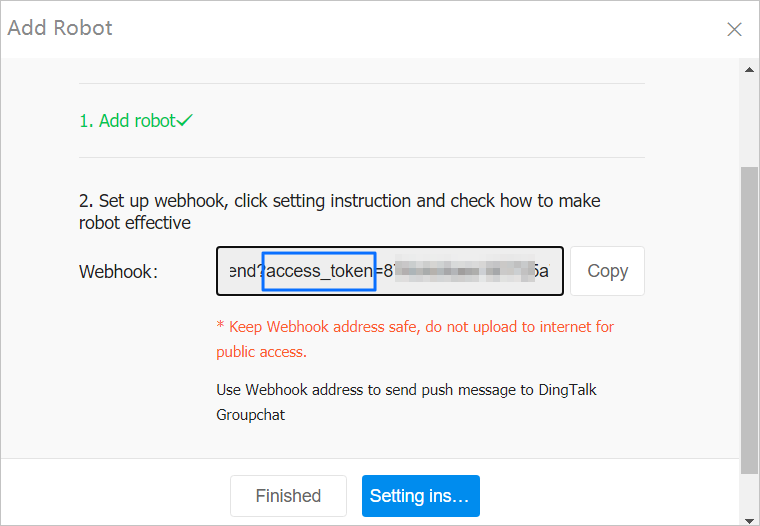
    Token information

  10. Click Finished.

Previous topic

View system alerts
Last

Next topic

Associate with OCP
Next
What is on this page
Background information
Alert settings
Create an alert channel
Obtain the access token of the DingTalk chatbot