

OceanBase logo

OceanBase

A unified distributed database ready for your transactional, analytical, and AI workloads.

Product Overview
DEPLOY YOUR WAY

OceanBase Cloud

The best way to deploy and scale OceanBase

OceanBase Enterprise

Run and manage OceanBase on your infra

TRY OPEN SOURCE

OceanBase Community Edition

The free, open-source distributed database

OceanBase seekdb

Open source AI native search database

Customer Stories

Real-world success stories from enterprises across diverse industries.

View All
BY USE CASES

Mission-Critical Transactions

Global & Multicloud Application

Elastic Scaling for Peak Traffic

Real-time Analytics

Active Geo-redundancy

Database Consolidation

Resources

Comprehensive knowledge hub for OceanBase.

Blog

Live Demos

Training & Certification

Documentation

Official technical guides, tutorials, API references, and manuals for all OceanBase products.

View All
PRODUCTS

OceanBase Cloud

OceanBase Database

Tools

Connectors and Middleware

QUICK START

OceanBase Cloud

OceanBase Database

BEST PRACTICES

Practical guides for utilizing OceanBase more effectively and conveniently

Company

Learn more about OceanBase – our company, partnerships, and trust and security initiatives.

About OceanBase

Partner

Trust Center

Contact Us

International - English
中国站 - 简体中文
日本 - 日本語
Sign In
Start on Cloud

OceanBase

A unified distributed database ready for your transactional, analytical, and AI workloads.

Product Overview
DEPLOY YOUR WAY

OceanBase Cloud

The best way to deploy and scale OceanBase

OceanBase Enterprise

Run and manage OceanBase on your infra

TRY OPEN SOURCE

OceanBase Community Edition

The free, open-source distributed database

OceanBase seekdb

Open source AI native search database

Customer Stories

Real-world success stories from enterprises across diverse industries.

View All
BY USE CASES

Mission-Critical Transactions

Global & Multicloud Application

Elastic Scaling for Peak Traffic

Real-time Analytics

Active Geo-redundancy

Database Consolidation

Comprehensive knowledge hub for OceanBase.

Blog

Live Demos

Training & Certification

Documentation

Official technical guides, tutorials, API references, and manuals for all OceanBase products.

View All
PRODUCTS
OceanBase CloudOceanBase Database
ToolsConnectors and Middleware
QUICK START
OceanBase CloudOceanBase Database
BEST PRACTICES

Practical guides for utilizing OceanBase more effectively and conveniently

Learn more about OceanBase – our company, partnerships, and trust and security initiatives.

About OceanBase

Partner

Trust Center

Contact Us

Start on Cloud
编组
All Products
    • Databases
    • iconOceanBase Database
    • iconOceanBase Cloud
    • iconOceanBase Tugraph
    • iconInteractive Tutorials
    • iconOceanBase Best Practices
    • Tools
    • iconOceanBase Cloud Platform
    • iconOceanBase Migration Service
    • iconOceanBase Developer Center
    • iconOceanBase Migration Assessment
    • iconOceanBase Admin Tool
    • iconOceanBase Loader and Dumper
    • iconOceanBase Deployer
    • iconKubernetes operator for OceanBase
    • iconOceanBase Diagnostic Tool
    • iconOceanBase Binlog Service
    • Connectors and Middleware
    • iconOceanBase Database Proxy
    • iconEmbedded SQL in C for OceanBase
    • iconOceanBase Call Interface
    • iconOceanBase Connector/C
    • iconOceanBase Connector/J
    • iconOceanBase Connector/ODBC
    • iconOceanBase Connector/NET
icon

OceanBase Cloud Platform

V4.3.1

    Download PDF

    OceanBase logo

    The Unified Distributed Database for the AI Era.

    Follow Us
    Products
    OceanBase CloudOceanBase EnterpriseOceanBase Community EditionOceanBase seekdb
    Resources
    DocsBlogLive DemosTraining & CertificationTicket
    Company
    About OceanBaseTrust CenterLegalPartnerContact Us
    Follow Us

    © OceanBase 2026. All rights reserved

    Cloud Service AgreementPrivacy PolicySecurity
    Contact Us
    Document Feedback
    1. Documentation Center
    2. OceanBase Cloud Platform
    3. V4.3.1
    iconOceanBase Cloud Platform
    V 4.3.1
    • V 4.3.6
    • V 4.3.5
    • V 4.3.4
    • V 4.3.3
    • V 4.3.2
    • V 4.3.1
    • V 4.3.0
    • V 4.2.2
    • V 4.0.0 and earlier

    ic_server_connect_failed Inter-Connector

    Last Updated:2026-04-14 07:46:02  Updated
    share
    What is on this page
    Description
    Principle
    Alert rule
    Alert information
    Alert templates
    Impact on the system
    Possible causes
    Suggested solutions

    folded

    share

    Description

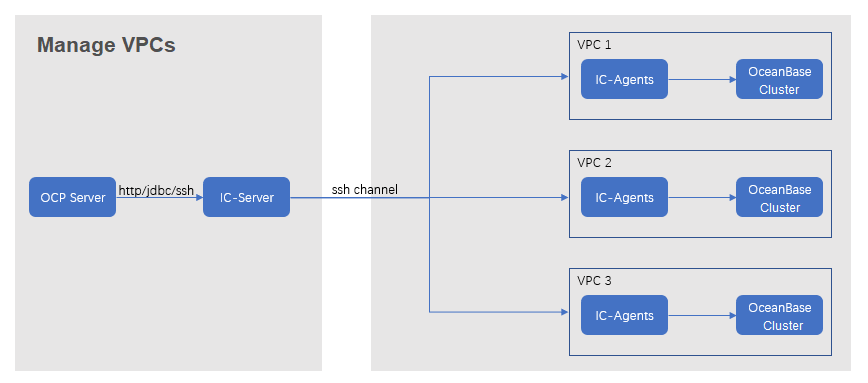
    OceanBase Cloud Platform (OCP) needs to manage OceanBase clusters in multiple virtual private clouds (VPCs) in multi-VPC mode. OCP accesses the services in these VPCs through secure channels established by IC-Servers and IC-Agents. An IC-Server provides a virtual IP (VIP) address for OCP and functions as the proxy for OCP to access other VPCs.

    This alert is triggered when the IC-Server cannot be connected.
    1217

    Principle

    The following table describes the key parameters that are involved in the monitoring and alerting logic.

    Parameter
    Value
    Metric ic_server_health
    Note
    The result returned by the health check interface. When the value is 0, the IC-Server cannot be connected.
    Source The interface for health check on an IC-Server. The URL of the interface is in the format of http:// IP :8088/ok. Replace IP with the IP address of the monitored host.
    Collected metric ic_server_health
    Metric expression min(ic_server_health{@LABELS}) by (@GBLABELS)
    Collection cycle 1 minute

    Alert rule

    Metric
    Default threshold
    Duration
    Alert cycle
    Elimination cycle
    ic_server_health 0 0 seconds 60 seconds 5 minutes

    Alert information

    Trigger method
    Alert level
    Scope
    Based on the expression of the metric Critical Server

    Alert templates

    • Overview: ${alarm_target} ${alarm_name}

    • Details: OCP node ${ocp_address} cannot connect to IC-Server ${ic_server_address}.

    • Overview example: xxx.xxx.xxx.xxx IC-Server connection failed

    • Details example: OCP node xxx.xxx.xxx.xxx cannot connect to IC-Server xxx.xxx.xxx.xxx.

    Impact on the system

    You cannot manage OceanBase clusters and resources of other VPCs in the OCP console.

    Possible causes

    • An error occurs on the host where an IC-Server is installed. As a result, the IC-Server cannot be connected.

    • OCP cannot connect to specific IC-Servers due to network issues.

    Suggested solutions

    1. Log on to the host where the disconnected IC-Server is installed to check whether the process related to the IC-Server is normal and whether errors are printed in the logs.

      1. Log on to the IC-Server host.

        • If you fail to log on to the host, troubleshoot and fix the errors until the logon succeeds.

        • If you can log on to the host, go to the next step.

      2. Run the following command to check whether the ic-server process is normal.

        ps -ef|grep ic-server
        
        • If the process is not started, run the supervisord restart ic-server command to restart the command.

        • If the process is started, go to the next step.

      3. Run the following command to check whether errors are printed in the log file ~/logs/ic-server/server.log of the IC-Server.

        grep -r "error"  
        ~/logs/ic-server/server.log
        

        Replace ~ with the actual deployment path of the IC-Server.

        • If error logs are printed, perform troubleshooting based on the errors.

        • If no error logs are printed, go to the next step.

    2. Check whether OCP cannot connect to specific IC-Servers due to network issues.

      For more information, see Network troubleshooting.

    3. Contact technical support for troubleshooting if the alert is not eliminated after all the preceding measures are taken.

    Previous topic

    host_disk_readonly
    Last

    Next topic

    vpc_connect_failed
    Next
    What is on this page
    Description
    Principle
    Alert rule
    Alert information
    Alert templates
    Impact on the system
    Possible causes
    Suggested solutions