

OceanBase logo

OceanBase

A unified distributed database ready for your transactional, analytical, and AI workloads.

Product Overview
DEPLOY YOUR WAY

OceanBase Cloud

The best way to deploy and scale OceanBase

OceanBase Enterprise

Run and manage OceanBase on your infra

TRY OPEN SOURCE

OceanBase Community Edition

The free, open-source distributed database

OceanBase seekdb

Open source AI native search database

Customer Stories

Real-world success stories from enterprises across diverse industries.

View All
BY USE CASES

Mission-Critical Transactions

Global & Multicloud Application

Elastic Scaling for Peak Traffic

Real-time Analytics

Active Geo-redundancy

Database Consolidation

Resources

Comprehensive knowledge hub for OceanBase.

Blog

Live Demos

Training & Certification

Documentation

Official technical guides, tutorials, API references, and manuals for all OceanBase products.

View All
PRODUCTS

OceanBase Cloud

OceanBase Database

Tools

Connectors and Middleware

QUICK START

OceanBase Cloud

OceanBase Database

BEST PRACTICES

Practical guides for utilizing OceanBase more effectively and conveniently

Company

Learn more about OceanBase – our company, partnerships, and trust and security initiatives.

About OceanBase

Partner

Trust Center

Contact Us

International - English
中国站 - 简体中文
日本 - 日本語
Sign In
Start on Cloud

OceanBase

A unified distributed database ready for your transactional, analytical, and AI workloads.

Product Overview
DEPLOY YOUR WAY

OceanBase Cloud

The best way to deploy and scale OceanBase

OceanBase Enterprise

Run and manage OceanBase on your infra

TRY OPEN SOURCE

OceanBase Community Edition

The free, open-source distributed database

OceanBase seekdb

Open source AI native search database

Customer Stories

Real-world success stories from enterprises across diverse industries.

View All
BY USE CASES

Mission-Critical Transactions

Global & Multicloud Application

Elastic Scaling for Peak Traffic

Real-time Analytics

Active Geo-redundancy

Database Consolidation

Comprehensive knowledge hub for OceanBase.

Blog

Live Demos

Training & Certification

Documentation

Official technical guides, tutorials, API references, and manuals for all OceanBase products.

View All
PRODUCTS
OceanBase CloudOceanBase Database
ToolsConnectors and Middleware
QUICK START
OceanBase CloudOceanBase Database
BEST PRACTICES

Practical guides for utilizing OceanBase more effectively and conveniently

Learn more about OceanBase – our company, partnerships, and trust and security initiatives.

About OceanBase

Partner

Trust Center

Contact Us

Start on Cloud
编组
All Products
    • Databases
    • iconOceanBase Database
    • iconOceanBase Cloud
    • iconOceanBase Tugraph
    • iconInteractive Tutorials
    • iconOceanBase Best Practices
    • Tools
    • iconOceanBase Cloud Platform
    • iconOceanBase Migration Service
    • iconOceanBase Developer Center
    • iconOceanBase Migration Assessment
    • iconOceanBase Admin Tool
    • iconOceanBase Loader and Dumper
    • iconOceanBase Deployer
    • iconKubernetes operator for OceanBase
    • iconOceanBase Diagnostic Tool
    • iconOceanBase Binlog Service
    • Connectors and Middleware
    • iconOceanBase Database Proxy
    • iconEmbedded SQL in C for OceanBase
    • iconOceanBase Call Interface
    • iconOceanBase Connector/C
    • iconOceanBase Connector/J
    • iconOceanBase Connector/ODBC
    • iconOceanBase Connector/NET
icon

OceanBase Migration Service

V4.2.11Community Edition

    Download PDF

    OceanBase logo

    The Unified Distributed Database for the AI Era.

    Follow Us
    Products
    OceanBase CloudOceanBase EnterpriseOceanBase Community EditionOceanBase seekdb
    Resources
    DocsBlogLive DemosTraining & CertificationTicket
    Company
    About OceanBaseTrust CenterLegalPartnerContact Us
    Follow Us

    © OceanBase 2026. All rights reserved

    Cloud Service AgreementPrivacy PolicySecurity
    Contact Us
    Document Feedback
    1. Documentation Center
    2. OceanBase Migration Service
    3. V4.2.11
    iconOceanBase Migration Service
    V 4.2.11Community Edition
    Enterprise Edition
    • V 4.3.2
    • V 4.3.1
    • V 4.3.0
    • V 4.2.5
    • V 4.2.4
    • V 4.2.3
    • V 4.0.2
    • V 3.4.0
    Community Edition
    • V 4.2.13
    • V 4.2.12
    • V 4.2.11
    • V 4.2.10
    • V 4.2.9
    • V 4.2.8
    • V 4.2.7
    • V 4.2.6
    • V 4.2.5
    • V 4.2.4
    • V 4.2.3
    • V 4.2.1
    • V 4.2.0
    • V 4.0.0
    • V 3.3.1

    Perform batch operations on data synchronization tasks

    Last Updated:2026-04-14 07:36:10  Updated
    Share
    What is on this page
    Background
    Go to the Synchronization Tasks page
    Batch pause
    Batch restore
    Batch release
    Batch start
    Batch delete
    Batch modify alert configuration

    folded

    Share

    This topic describes how to perform batch operations on data synchronization tasks by using OceanBase Migration Service (OMS).

    Background

    OMS allows you to perform operations on multiple data synchronization tasks at a time on the Synchronization Tasks page. Supported batch operations on data synchronization tasks vary based on the task states.

    Task status
    Supported batch operation
    Not Started Batch start, batch delete, and batch modify alert configuration
    Running Batch pause and batch modify alert configuration
    Paused Batch restore, batch release, and batch modify alert configuration
    Failed Batch restore, batch release, and batch modify alert configuration
    Released Batch delete
    Releasing N/A
    Completed Batch release

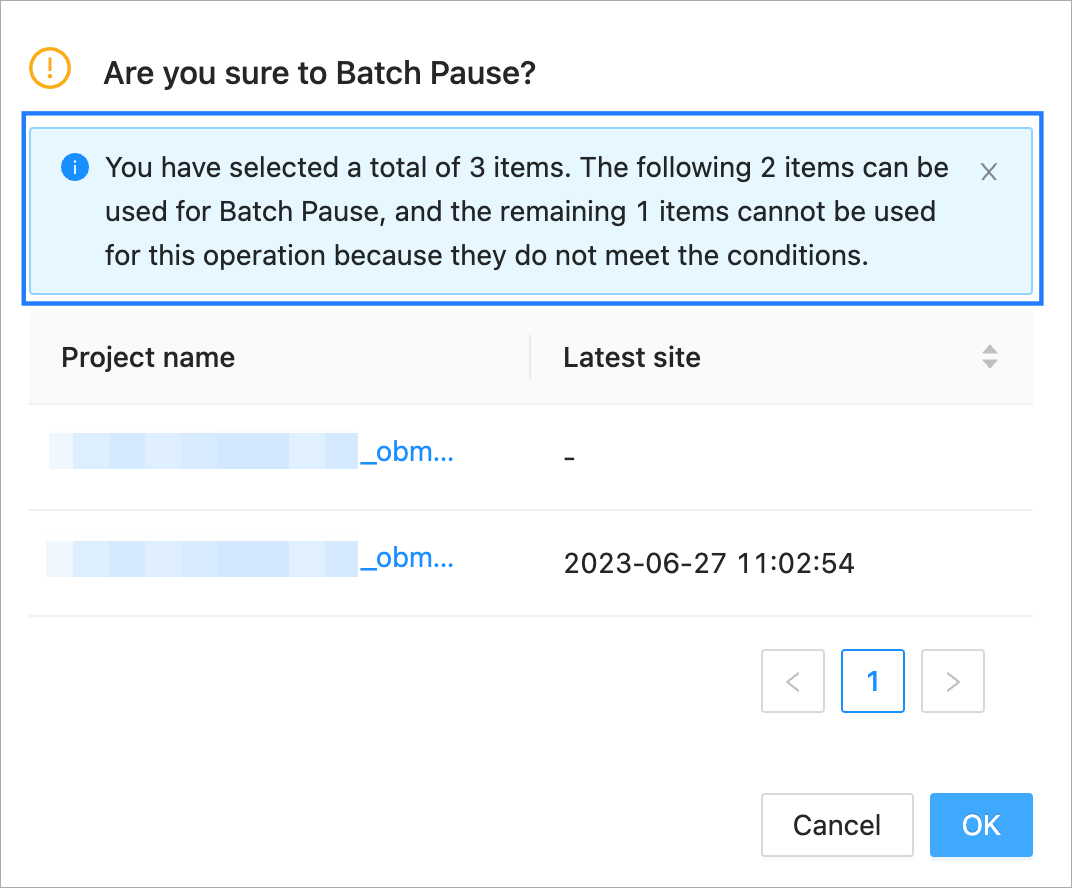
    If you select multiple tasks for a batch operation, but not all tasks support this batch operation, a dialog box appears and displays the tasks that support this batch operation.
    batch-pause-en

    Go to the Synchronization Tasks page

    1. Log in to the OMS console.

    2. In the left-side navigation pane, choose Data Synchronization. The Synchronization Tasks page automatically appears.

      You can select data synchronization tasks for a batch operation.

    Batch pause

    OMS allows you to batch pause data synchronization tasks in the Running state.

    1. On the Synchronization Tasks page, select the data synchronization tasks to be paused.

    2. Click Batch Pause in the lower part of the page.

    3. In the dialog box that appears, click OK.

      This dialog box will display the number of tasks that support batch pausing, the task names, and the latest timestamps.

    4. After the operation succeeds, the number of tasks that are successfully paused is displayed.

      For any task that failed the batch operation, troubleshoot the issue as prompted.

    Batch restore

    OMS allows you to batch restore data synchronization tasks in the Stopped or Failed state.

    1. On the Synchronization Tasks page, select the data synchronization tasks to be restored.

    2. Click Batch Restore in the lower part of the page.

    3. In the dialog box that appears, click OK.

      This dialog box will display the number of tasks that support batch restoration, the task names, and the latest timestamps.

    4. After the operation succeeds, the number of tasks that are successfully restored is displayed.

      For any task that failed the batch operation, troubleshoot the issue as prompted.

    Batch release

    OMS allows you to batch release data synchronization tasks in the Stopped, Failed, or Completed state.

    1. On the Synchronization Tasks page, select the data synchronization tasks to be released.

    2. Click Batch Release in the lower part of the page.

    3. In the dialog box that appears, click OK.

      This dialog box will display the number of tasks that support batch release, the task names, and the latest timestamps.

    4. After the operation succeeds, the number of tasks that are successfully released is displayed.

      For any task that failed the batch operation, troubleshoot the issue as prompted.

    Batch start

    OMS allows you to batch start data synchronization tasks in the Not Started state.

    1. On the Synchronization Tasks page, select the data synchronization tasks for batch start.

    2. Click Batch Start in the lower part of the page.

    3. In the dialog box that appears, click OK.

      This dialog box will display the number of tasks that support batch start, the task names, and the latest timestamps.

    4. After the operation succeeds, the number of tasks that are successfully started is displayed.

      For any task that failed the batch operation, troubleshoot the issue as prompted.

    Batch delete

    OMS allows you to batch delete data synchronization tasks in the Not Started or Released state.

    1. On the Synchronization Tasks page, select the data synchronization tasks for batch deletion.

    2. Choose More Batch Operations > Batch Delete in the lower part of the page.

    3. In the dialog box that appears, click OK.

      This dialog box will display the number of tasks that support batch deletion, the task names, and the latest timestamps.

    4. After the operation succeeds, the number of tasks that are successfully deleted is displayed.

      For any task that failed the batch operation, troubleshoot the issue as prompted.

    Batch modify alert configuration

    OMS allows you to batch modify alert configuration of data synchronization tasks in the Not Started, Running, Stopped, or Failed state.

    1. On the Synchronization Tasks page, select the data synchronization tasks whose alert settings are to be modified.

    2. Choose More Batch Operations > Batch Modify Alert Configuration in the lower part of the page.

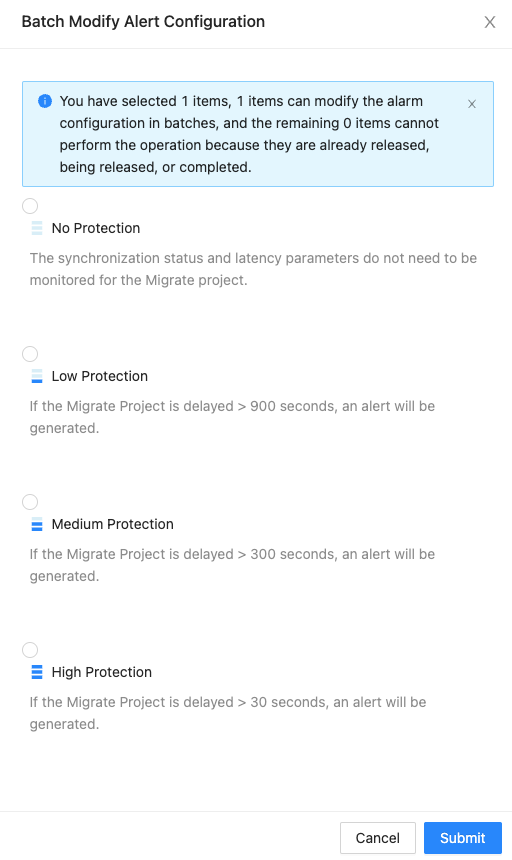
    3. In the Batch Configure Alerts dialog box, specify the related parameters.
      batch-modify-alert-en

      OMS supports the following alert levels: No Protection, High Protection, Medium Protection, and Low Protection. For more information, see Alert settings.

    4. Click Submit.

      To view the alerts generated for a data migration or synchronization task, see View task alerts.

    5. After the alert settings are modified for the selected tasks, a prompt is displayed on the page. For any task that failed the batch operation, troubleshoot the issue as prompted.

    Previous topic

    Use tags to manage data synchronization tasks
    Last

    Next topic

    Download and import the settings of synchronization objects
    Next
    What is on this page
    Background
    Go to the Synchronization Tasks page
    Batch pause
    Batch restore
    Batch release
    Batch start
    Batch delete
    Batch modify alert configuration