

OceanBase logo

OceanBase

A unified distributed database ready for your transactional, analytical, and AI workloads.

Product Overview
DEPLOY YOUR WAY

OceanBase Cloud

The best way to deploy and scale OceanBase

OceanBase Enterprise

Run and manage OceanBase on your infra

TRY OPEN SOURCE

OceanBase Community Edition

The free, open-source distributed database

OceanBase seekdb

Open source AI native search database

Customer Stories

Real-world success stories from enterprises across diverse industries.

View All
BY USE CASES

Mission-Critical Transactions

Global & Multicloud Application

Elastic Scaling for Peak Traffic

Real-time Analytics

Active Geo-redundancy

Database Consolidation

Resources

Comprehensive knowledge hub for OceanBase.

Blog

Live Demos

Training & Certification

Documentation

Official technical guides, tutorials, API references, and manuals for all OceanBase products.

View All
PRODUCTS

OceanBase Cloud

OceanBase Database

Tools

Connectors and Middleware

QUICK START

OceanBase Cloud

OceanBase Database

BEST PRACTICES

Practical guides for utilizing OceanBase more effectively and conveniently

Company

Learn more about OceanBase – our company, partnerships, and trust and security initiatives.

About OceanBase

Partner

Trust Center

Contact Us

International - English
中国站 - 简体中文
日本 - 日本語
Sign In
Start on Cloud

OceanBase

A unified distributed database ready for your transactional, analytical, and AI workloads.

Product Overview
DEPLOY YOUR WAY

OceanBase Cloud

The best way to deploy and scale OceanBase

OceanBase Enterprise

Run and manage OceanBase on your infra

TRY OPEN SOURCE

OceanBase Community Edition

The free, open-source distributed database

OceanBase seekdb

Open source AI native search database

Customer Stories

Real-world success stories from enterprises across diverse industries.

View All
BY USE CASES

Mission-Critical Transactions

Global & Multicloud Application

Elastic Scaling for Peak Traffic

Real-time Analytics

Active Geo-redundancy

Database Consolidation

Comprehensive knowledge hub for OceanBase.

Blog

Live Demos

Training & Certification

Documentation

Official technical guides, tutorials, API references, and manuals for all OceanBase products.

View All
PRODUCTS
OceanBase CloudOceanBase Database
ToolsConnectors and Middleware
QUICK START
OceanBase CloudOceanBase Database
BEST PRACTICES

Practical guides for utilizing OceanBase more effectively and conveniently

Learn more about OceanBase – our company, partnerships, and trust and security initiatives.

About OceanBase

Partner

Trust Center

Contact Us

Start on Cloud
编组
All Products
    • Databases
    • iconOceanBase Database
    • iconOceanBase Cloud
    • iconOceanBase Tugraph
    • iconInteractive Tutorials
    • iconOceanBase Best Practices
    • Tools
    • iconOceanBase Cloud Platform
    • iconOceanBase Migration Service
    • iconOceanBase Developer Center
    • iconOceanBase Migration Assessment
    • iconOceanBase Admin Tool
    • iconOceanBase Loader and Dumper
    • iconOceanBase Deployer
    • iconKubernetes operator for OceanBase
    • iconOceanBase Diagnostic Tool
    • iconOceanBase Binlog Service
    • Connectors and Middleware
    • iconOceanBase Database Proxy
    • iconEmbedded SQL in C for OceanBase
    • iconOceanBase Call Interface
    • iconOceanBase Connector/C
    • iconOceanBase Connector/J
    • iconOceanBase Connector/ODBC
    • iconOceanBase Connector/NET
icon

OceanBase Cloud Platform

V4.4.2

    Download PDF

    OceanBase logo

    The Unified Distributed Database for the AI Era.

    Follow Us
    Products
    OceanBase CloudOceanBase EnterpriseOceanBase Community EditionOceanBase seekdb
    Resources
    DocsBlogWhite PaperLive DemosTraining & CertificationTicket
    Company
    About OceanBaseTrust CenterLegalPartnerContact Us
    Follow Us

    © OceanBase 2026. All rights reserved

    Cloud Service AgreementPrivacy PolicySecurity
    Contact Us
    Document Feedback
    1. Documentation Center
    2. OceanBase Cloud Platform
    3. V4.4.2
    iconOceanBase Cloud Platform
    V 4.4.2
    Databases
    • OceanBase Database
    • OceanBase Cloud
    • OceanBase Tugraph
    • Interactive Tutorials
    • OceanBase Best Practices
    Tools
    • OceanBase Cloud Platform
    • OceanBase Migration Service
    • OceanBase Developer Center
    • OceanBase Migration Assessment
    • OceanBase Admin Tool
    • OceanBase Loader and Dumper
    • OceanBase Deployer
    • Kubernetes operator for OceanBase
    • OceanBase Diagnostic Tool
    • OceanBase Binlog Service
    Connectors and Middleware
    • OceanBase Database Proxy
    • Embedded SQL in C for OceanBase
    • OceanBase Call Interface
    • OceanBase Connector/C
    • OceanBase Connector/J
    • OceanBase Connector/ODBC
    • OceanBase Connector/NET
    • V 4.4.2
    • V 4.3.6
    • V 4.3.5
    • V 4.3.4
    • V 4.3.3
    • V 4.3.2
    • V 4.3.1
    • V 4.3.0
    • V 4.2.2
    • V 4.0.0 and earlier

    Client configuration

    Last Updated:2026-06-10 02:35:40  Updated
    Share
    What is on this page
    Prerequisites
    Add an application
    Modify an application
    Delete an application

    folded

    Share

    To implement load balancing of business traffic, the client driver such as the JDBC driver needs the corresponding traffic entry nodes and traffic allocation strategy. Through client configuration, you can synchronize the node information and load balancing strategy of an OBProxy cluster as an application to the client program. The client obtains the application configuration information for load balancing.

    Prerequisites

    Make sure that you have the following permissions:

    • Resource Permissions: OBProxy Maintenance permission
    • Menu Permissions: Permission on the Client Configuration menu of OBProxy

    Add an application

    1. Log on to the OceanBase Cloud Platform (OCP) console.

    2. In the left-side navigation pane, click OBProxy.

    3. In the OBProxy cluster list, click the target OBProxy cluster. Then, the Overview page of the OBProxy cluster appears.

    4. In the left-side navigation pane, click Client Configuration. Then, the Client Configuration overview page appears.

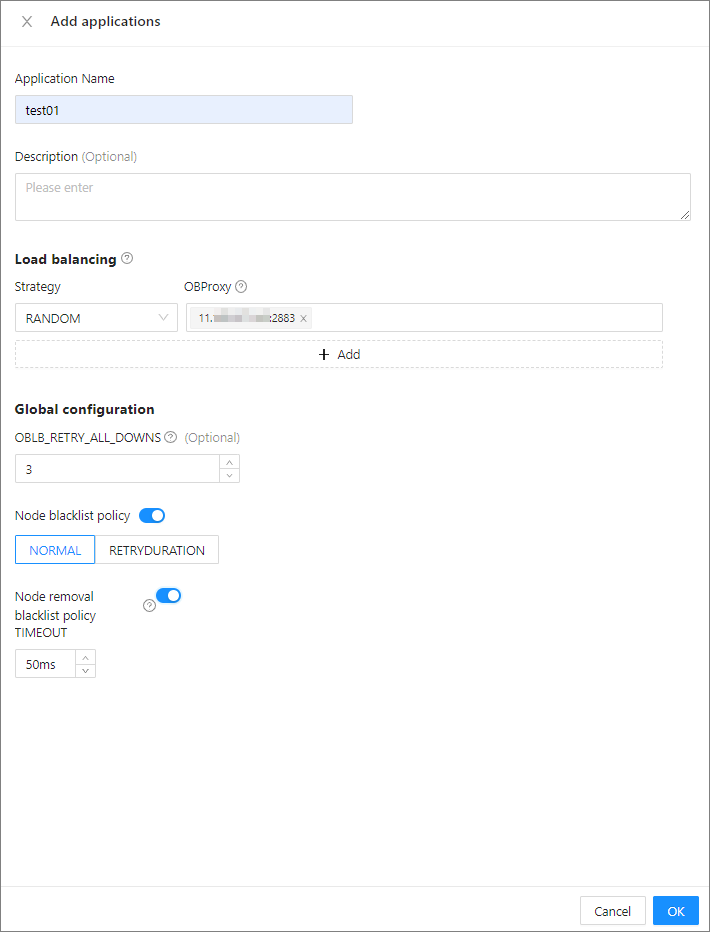
    5. Click Add Application in the upper-right corner and then enter application information in the right-side pane.

      Parameter
      Description
      Application Name The name of the application. It must begin with a letter and can contain 4 to 32 letters, digits, and underscores (_).
      Notice
      The application name is globally unique in OCP.
      Description Optional. The description of the application, which must be 0 to 256 characters in length.
      Load Balancer If multiple load balancing strategies are configured, the client program applies the load balancing configuration in polling mode based on the sequence of configured load balancing strategies.**** You must configure at least one load balancing strategy for the application.
      Strategy The load balancing strategy. Valid values: RANDOM, SERVERAFFINITY, and ROTATION. You cannot select a strategy repeatedly.
      • RANDOM: random
      • SERVERAFFINITY: weighting
      • ROTATION: polling
      OBProxy The OBProxy list for the load balancing strategy in the IP address:Port number (weight) format. You can select multiple OBProxies. The weight is used only when the load balancing strategy is set to SERVERAFFINITY. The value range for weight is 1 to 10. A greater number indicates a higher weight.
      Global Configuration The global configuration information about the application.
      OBLB_RETRY_ALL_DOWNS Optional. The number of connection attempts to all nodes. When this threshold is exceeded, a connection exception is thrown.
      Node Blacklist Strategy The strategy for blacklisting a node, which is disabled by default. Valid values: NORMAL and RETRYTIMES.
      • NORMAL: the normal strategy. This is the default strategy. If a network exception is thrown for a connection attempt to a node, this node will be blacklisted and no other parameters are needed for judgment.
      • RETRYTIMES: specifies to retry within the specified period. After the specified number of retry attempts to a node is exceeded, the node is blacklisted. The blacklisting judgment is made based on the RETRYTIMES and DURATION parameters.
      DURATION The period for retry attempts. This parameter is displayed when Node Blacklist Strategy is set to RETRYTIMES.
      RETRYTIMES The period for retry attempts. This parameter is displayed when Node Blacklist Strategy is set to RETRYTIMES.
      Node Unblacklist Strategy If this strategy is enabled, a node will be removed from the blacklist when the specified timeout period expires.
      TIMEOUT The timeout period for blacklisting a node. A node will be removed from the blacklist when the timeout period expires. This parameter is displayed when Node Unblacklist Strategy is enabled.
      1

    6. Click OK.

    Modify an application

    1. Log on to the OCP console.

    2. In the left-side navigation pane, click OBProxy.

    3. In the OBProxy cluster list, click the target OBProxy cluster. Then, the Overview page of the OBProxy cluster appears.

    4. In the left-side navigation pane, click Client Configuration. Then, the Client Configuration overview page appears.

    5. Select the application to edit and then click Edit in the upper-right corner.

    6. In the dialog box that appears, modify related information and then click OK to save the modifications.

    Delete an application

    1. Log on to the OCP console.

    2. In the left-side navigation pane, click OBProxy.

    3. In the OBProxy cluster list, click the target OBProxy cluster. Then, the Overview page of the OBProxy cluster appears.

    4. In the left-side navigation pane, click Client Configuration. Then, the Client Configuration overview page appears.

    5. Select the application to delete and then click Delete in the upper-right corner.

    6. In the dialog box that appears, click Yes.

      Note

      After you delete an application, the client program cannot reference this configuration instance for load balancing. Proceed with caution.

    Previous topic

    Manage OBProxy cluster parameters
    Last

    Next topic

    Manage OBProxy parameter templates
    Next
    What is on this page
    Prerequisites
    Add an application
    Modify an application
    Delete an application