Meet OceanBase AI Lakebase, the unified database for operational data, real-time analytics, and AI.
Meet OceanBase AI Lakebase, the unified database for operational data, real-time analytics, and AI. Explore ->
OceanBase 4.4.2 LTS: Integrating Transactions, Analytics, and AI in One Unified Database

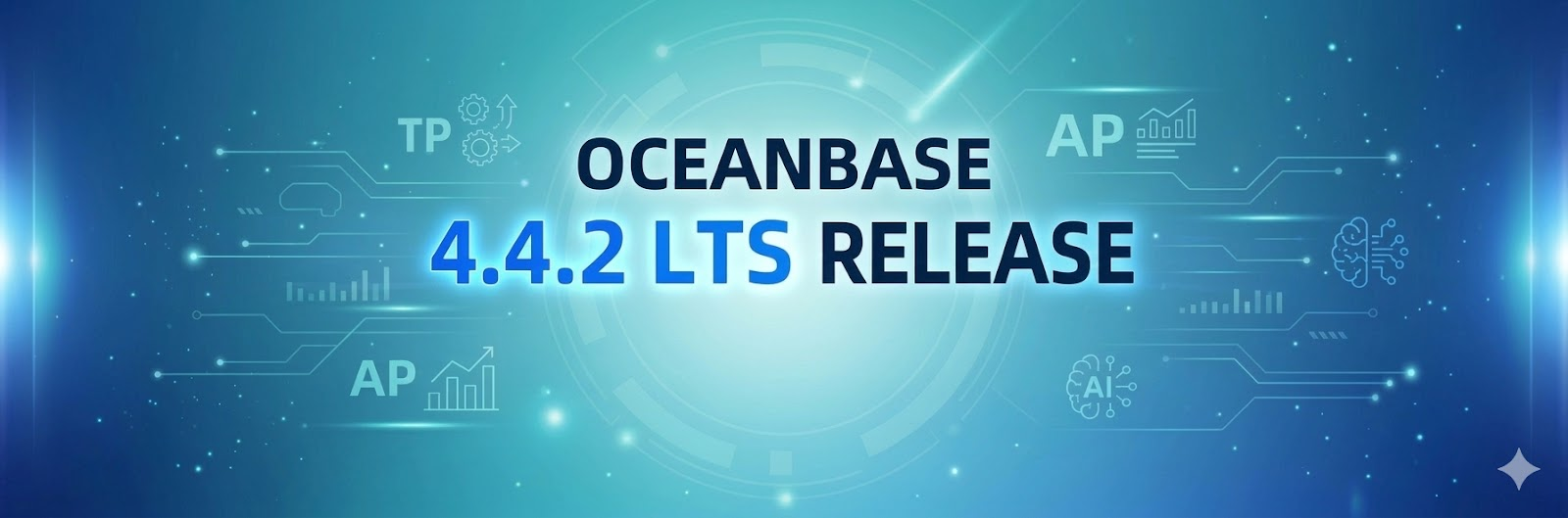
OceanBase 4.4.2 LTS: Integrating Transactions, Analytics, and AI in One Unified DatabaseOceanBase 4.4.2 is now generally available as a Long-Term Support (LTS) release. This is the first OceanBase version to deeply integrate transactional (TP), analytical (AP), and AI workloads into a single, unified engine — so you can stop stitching together separate OLTP, OLAP, and vector databases to run your data stack.
V4.4.2 delivers comprehensive kernel improvements in data management, compatibility, security, and operational diagnostic. It has been extensively tested and is recommended for production use across TP, AP, HTAP, and AI workloads.
The problem with fragmented data stacks
Most teams today run at least three types of databases: a transactional store for core business logic, an analytical engine for reporting and BI, and increasingly, a vector database for AI workloads like RAG and semantic search.
Each one adds operational surface area. Data gets copied between systems, ETL pipelines introduce latency and consistency gaps, and your team ends up maintaining and context-switching between multiple technology stacks. When an AI model needs the freshest transactional data to make a decision, it’s stuck waiting for the next sync job.
4.4.2 LTS is built to collapse this complexity. This means you can use one database handles transactions, analytics, and AI inference — with data that’s always fresh, always consistent, in one place.
Transaction processing that keeps up with your business
At its core, OceanBase remains a distributed transactional database built for high-concurrency, strong-consistency workloads. 4.4.2 LTS makes that foundation faster and easier to operate.
Faster iteration cycles
This release improves serial DDL performance by roughly 60%, which directly translates to faster table creation during rollouts and schema migrations. For teams practicing continuous deployment, that’s less time spent waiting on DDL locks during release windows.
More flexible data lifecycle management
Two-level partitioned tables now support subpartition-to-partition exchange, making bulk data loading, historical data archiving, and partition reorganization significantly simpler. If you’re managing tables with time-based retention policies or rolling data windows, this directly reduces the operational complexity of keeping your data organized.
More robust intermediate logic in-database
Session-level private temporary tables are now fully supported in MySQL mode. If your application logic relies on temp tables for mid-transaction computation, for example, staging, deduplication, or intermediate joins, this closes a real gap.
Boost throughput on modern hardware
Parallel Data Manipulation Language (PDML) performance is up ~25% on high-spec CPUs, and follower read stability has been enhanced. UDF and trigger execution in PL now supports asynchronous transaction submission, reducing overhead for stored business logic. The result? Better resource utilization and more headroom before you need to scale out.
Real-time analytics without the wait
The value of analytical insight degrades with time. If your team has to wait hours for ETL jobs to land data in a separate analytics system, you’re making decisions on stale information. OceanBase 4.4.2 LTS integrates the large-scale analytical engine from 4.3.5 LTS and makes it substantially more capable — so you can run complex queries directly on live operational data.
Materialized views, rebuilt from the ground up
This is the headline AP improvement. You now get full DDL support, optimized incremental refresh, cascading refresh for nested materialized views, and the ability to create materialized views on tables without primary keys.
With this, you can build pre-computed views that dramatically accelerate your most expensive analytical queries, while keeping them automatically up to date with minimal compute overhead.
Scale reads horizontally
Replicated table follower query performance has improved ~14x, nearly matching leader query speed. If you’ve been routing all analytical reads to leaders and worrying about read-write contention, followers are now a real option for offloading read-heavy workloads.
Better SQL compatibility for complex queries
Recursive CTEs in MySQL compatible mode now support UNION DISTINCT semantics, ensuring consistent deduplication in recursive queries. The Oracle support now adds INTERVAL partitioning, which automatically creates new partitions as data arrives beyond existing ranges — eliminating a common source of manual partition management.
Build AI features on your operational data
Most AI architectures today require copying data from your operational database into a separate vector store. That copy introduces staleness, sync complexity, and yet another system to manage. OceanBase 4.4.2 LTS brings vector search and hybrid query capabilities directly into the database engine.
Full-stack vector search
Vector similarity search is supported from the storage layer through indexing to the query engine. You can run vector queries alongside traditional scalar filters and full-text search in a single statement — exactly what RAG pipelines, semantic search, and recommendation systems need.
AI inference on fresh data
Because your transactional, analytical, and vector data all live in the same engine, AI applications query the latest data directly. No ETL lag. No stale embeddings. Your models reason over what’s happening now, not what happened when the last sync job ran.
Expanded geospatial support
Oracle support now adds spatial geometry functions including SDO_CONTAINS, SDO_ANYINTERACT, SDO_AREA, and SDO_UTIL.GETVERTICES — covering containment checks, intersection detection, area calculation, and vertex extraction for GIS and location-intelligence workloads.
Stronger KV performance
OBKV continues to mature as a high-throughput key-value interface. 4.4.2 LTS introduces weak reads, TTL-based index scans, hot key query optimization, and unified monitoring, making OceanBase a more capable backend for high-throughput microservice architectures that need key-value access patterns.
Security and operations: built for production
A unified database only delivers value if it’s production-ready — secure, observable, and operationally flexible.
Transparent column encryption. Encrypt sensitive columns without changing a single query or migrating your schema. Your application doesn’t know or care that encryption is happening — but your compliance team will.
Better diagnostics for DBAs. Deadlock detection has been improved, Active Session History (ASH) data is more complete, and SQLSTAT statistics have been rebuilt for greater granularity. When you’re hunting down a performance bottleneck or a problematic query pattern, you’ll have more reliable data to work with.
Heterogeneous zone deployment. Tenants can now run with different UNIT_NUM configurations across zones. When a node fails, you remove it directly — no need to reconfigure other zones. A node going down in one zone no longer disrupts load balancing elsewhere. The result is smoother scaling and less operational risk during failure recovery.
Why consolidate now
Running separate TP, AP, and vector databases isn’t just expensive — it’s slow. Slow to build on, slow to operate, slow to evolve. With OceanBase 4.4.2 LTS, you get a single system that handles all three workloads, which means:
Get started
If you’re evaluating a database architecture upgrade — or simply tired of maintaining a fragmented data stack — give OceanBase 4.4.2 LTS a try.
We’ll be publishing a deep-dive series on TP, AP, AI, and single-node deployment scenarios in the coming weeks. Stay tuned.


Keep Reading
View all posts
Exploring OceanBase 4.3: New Features and Enhancements
At the OceanBase DevCon 2024, we introduced the OceanBase 4.3.0 Beta, unveiling a brand new columnar engine. This release achieves near petabyte-scale, real-time analytics in seconds, and enhances the integration of TP and AP capabilities.


How seekdb M0 Gives OpenClaw Persistent Memory and Shared Experience
OpenClaw's memory degrades over time—an architectural limitation, not a configuration issue. seekdb M0 solves this with cloud-based memory that persists across sessions and shares learned experience across agents.
Inside OceanBase Multi-Tenancy: Resource Isolation, Allocation and Governance
OceanBase multi-tenancy consolidates many business systems into one cluster with tenant-level CPU, memory, and IOPS quotas — without the interference of a shared instance.