Meet OceanBase AI Lakebase, the unified database for operational data, real-time analytics, and AI.
Meet OceanBase AI Lakebase, the unified database for operational data, real-time analytics, and AI. Explore ->
How seekdb M0 Gives OpenClaw Persistent Memory and Shared Experience
You've probably lived this moment.
Yesterday afternoon, you and your OpenClaw agent spent two hours debugging a production issue. It pulled logs, checked configs, tried several approaches, and finally pinpointed the culprit: a connection pool misconfiguration. Along the way, you discussed the dependency graph between three services and outlined a refactoring plan for next week.
This morning, you ask it to continue with the refactoring you discussed.
"Happy to help! Could you give me some context on which refactoring you're referring to?"
Everything from yesterday—the debugging journey, the insights about service dependencies, the plan you agreed on—gone. Wiped clean with the session.
This isn't a bug. It's a fundamental limitation of how OpenClaw handles memory. And if you've been using AI coding assistants seriously, you've felt the friction.
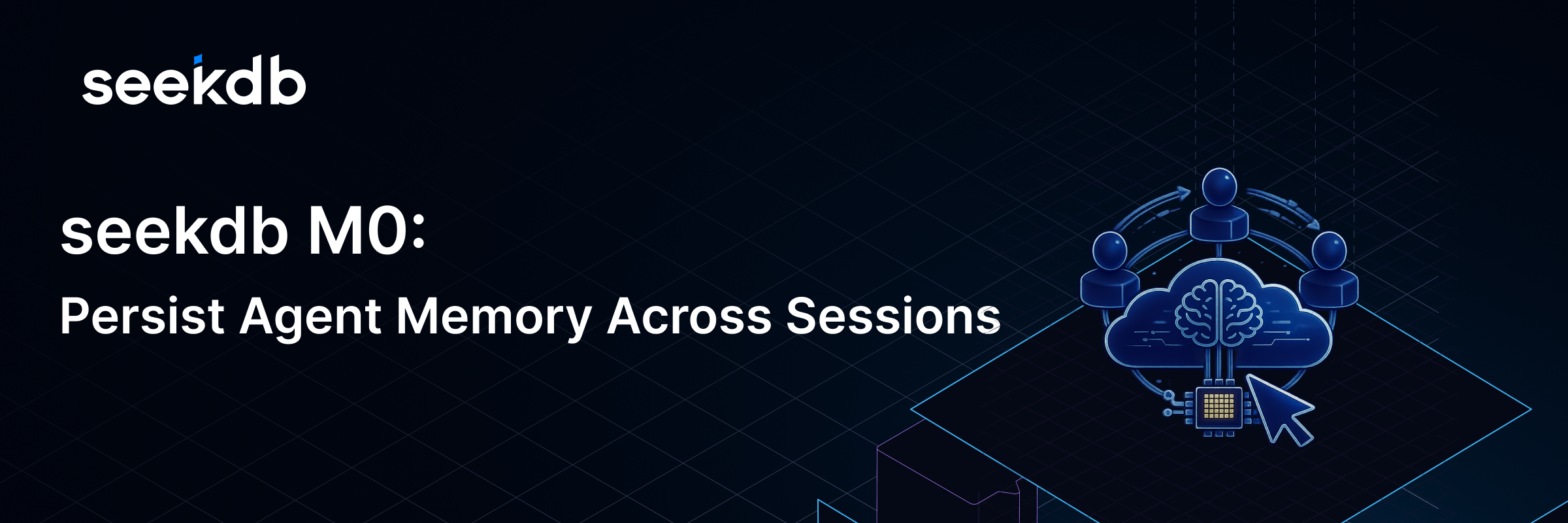
seekdb M0 is designed to fix this. It's a cloud memory plugin for OpenClaw that makes memories persist across sessions and—more interestingly—lets agents share learned experience with each other.
Why OpenClaw's Memory Degrades
Before jumping to solutions, it's worth understanding what's actually breaking.
OpenClaw has memory mechanisms—a MEMORY.md file and SQLite-based semantic retrieval. But in long-term use, these mechanisms fall into two vicious cycles.
Cycle one: The more you remember, the more you pay.
When the agent decides something is important, it writes to MEMORY.md. This file gets loaded into every request's system prompt. The longer you use OpenClaw, the larger MEMORY.md grows, the more input tokens each API call consumes, and the slower responses become. There's a default 20K character limit per file (150K total for bootstrap), but well before hitting that ceiling, a bloated context squeezes out the agent's working space.
And here's the trap: the agent knows information might get lost, so it becomes more aggressive about stuffing things into MEMORY.md—accelerating the bloat.
Cycle two: The more you forget, the more you fail.
When sessions get too long, OpenClaw triggers two mechanisms. First, compaction—using an LLM to summarize and compress old conversation segments. Second, memory flush—spawning an embedded agent to decide what important information to write to memory/YYYY-MM-DD.md before compaction.
But compaction summaries are lossy compression. And the retrieval side slices content by line count and character budget (default: 400 tokens per chunk), without respecting semantic boundaries. Critical context gets cut in half. Retrieval quality suffers. The agent can't find what it needs, makes mistakes, you correct it, more conversation accumulates, and the next compaction triggers sooner.
Tool calls accelerate both cycles. This is something many OpenClaw users don't realize. The intermediate results from tool calls—web pages from web_fetch, command outputs from exec—can be up to 400K characters each. These fill sessions fast. The information isn't suitable for MEMORY.md, but it might contain valuable insights. Either way, tool-heavy workflows make both vicious cycles spin faster.
The underlying tension: remembering is expensive, forgetting is costly.
You need a third option.
seekdb M0: Memory That Lives Outside the Context Window
seekdb M0 is a cloud memory plugin for OpenClaw. The core idea fits in one sentence: instead of stuffing all memories into the system prompt, retrieve only the relevant memory fragments before each conversation begins.
Unlike MEMORY.md's full-load approach, M0 breaks memories into independent facts stored in a cloud database. Each fact has both a vector representation and a full-text index. Before a conversation starts, M0 uses hybrid retrieval (BM25 + vector similarity) to find the most relevant memories and inject them into context. After the conversation ends, it automatically extracts new facts from the dialogue, compares them against existing memories, and decides whether to add, update, or skip.
What this means in practice:
The entire process is transparent—you just talk to your agent, and M0 handles memory management in the background.
But if M0 were just "MEMORY.md in the cloud," the value proposition would be limited. The real difference is in how it manages memories.
Two-Phase Memory Management
OpenClaw's native memory persistence relies on compaction summaries and the memory flush agent—both process full conversation content (including all tool outputs), burn tokens, and lose information. M0 takes a different approach: it separates "what to store" from "how to store it" into two independent phases.
Phase 1: Fact extraction
After a conversation ends, M0 extracts only the user-assistant dialogue (skipping all tool call outputs) and uses an LLM to pull out atomic facts. "User is Zhang San, a database engineer working in Hangzhou" becomes three separate facts.
Extraction follows hard rules: temporal information must be preserved ("went to Hawaii last year" stays intact, not simplified to "went to Hawaii"); original language is kept (no translation); sensitive information is never extracted.
Phase 2: Memory decision
Extracted facts don't go directly into the database. First, M0 uses vector retrieval to find the most similar existing memories, then asks an LLM to judge: should this fact be added (ADD), update an existing memory (UPDATE), delete a conflicting memory (DELETE), or be skipped because it's already covered (NONE)?
New fact: "Went to Hawaii last May"Existing memory: "Has been to Hawaii"→ Decision: UPDATE (adds temporal context)New fact: "No longer likes pizza"Existing memory: "Likes pizza"→ Decision: UPDATE (preference changed)New fact: "Is a software engineer"Existing memories: "Name is John", "Is a software engineer"→ Decision: NONE (already covered)In practice, the plugin treats DELETE as NONE to prevent accidental erasure—auto-capture only adds and updates, never deletes existing records.
One implementation detail worth noting: when facts are sent to the LLM for decision-making, existing memory IDs are replaced with temporary indices (0, 1, 2...) to prevent the model from hallucinating long integer IDs. If the model returns an unmappable ID, the system gracefully degrades to ADD.
This two-phase design achieves separation of concerns—extraction ensures fact quality and compliance, while decision-making keeps the memory store from growing unboundedly.
Tool Output Compression: Zero LLM Cost
Earlier I mentioned that tool call outputs are the main driver of session bloat. M0's approach is direct: compress with deterministic rules, spend zero LLM tokens.
When tool results are persisted to conversation history, M0's tool_result_persist hook intercepts them and replaces raw output with a structured summary:
Original: web_fetch returned a 3000-line JSON responseCompressed:[tool_result: web_fetch]input: {"url": "https://api.example.com/users"}status: successoutput: 3000 lines / 48000 characterspreview: {"users": [{"id": 1, "name": "Alice"... ...(re-run the tool for full output)Compression ratios are extreme (tens of thousands of characters → a few hundred), and it's entirely rule-based—no LLM needed to understand content, just preserve "what was done, what happened, brief preview."
During fact extraction, M0 skips all tool/toolResult messages entirely, looking only at human-agent dialogue. Even if a conversation involves heavy tool usage, the LLM input for fact extraction stays small.
Compared to OpenClaw's native approach—compacting full sessions (including all tool outputs) through an LLM—this controls data volume at the source rather than doing lazy compression after overflow.
The Experience System: From Fresh Graduate to Expert
Memory solves "remembering who the user is and what they like." But OpenClaw users have another frustration: agents have skills, but no practical experience.
An OpenClaw agent loaded with various skills is like a fresh graduate—professional knowledge is there, but when it comes to actually getting things done, they hit problems no textbook ever covered.
Example: A production service is returning 503s. The agent investigates, finds logs full of "connection refused," but the database is healthy. After twenty minutes of back-and-forth, the real culprit emerges: a slow query had exhausted all connections in the pool. Kill the slow query, service recovers.
This troubleshooting experience won't be written in any skill documentation—"when database is healthy but service reports connection refused, check if connection pool is exhausted by slow queries"—it's pure practical wisdom, learned only by hitting the problem.
The frustration: next time another OpenClaw user hits the same symptoms, their agent starts from scratch and spends another twenty minutes.
Humans face the same problem—juniors learn by trial and error, veterans spot issues instantly. But there's one fundamental difference between humans and agents: humans can't share brains. Agents can.
That's what M0's experience system does: let one OpenClaw agent's hard-won lessons benefit all OpenClaw agents. The first agent spends twenty minutes reaching a conclusion; the second agent, facing similar symptoms, sees that conclusion immediately—not because it went through the same struggle, but because another agent already did and shared the learning.
Experience and memory are different things. Memory is personal facts—"user prefers dark mode," "user lives in Hangzhou." Experience is general wisdom—"when database is healthy but service won't connect, check connection pool first," "deploying to containers requires setting LANG=C.UTF-8 or Chinese characters break."
The experience system has four phases:
Auto-distillation. When a conversation succeeds and involves tool calls, M0 asynchronously analyzes the interaction in the background and extracts reusable experience. This process is non-blocking and doesn't affect normal conversation.
Tiered verification. New experiences don't immediately go public. They have a lifecycle—Draft (just extracted, visible only to creator) → Published (positive feedback reaches threshold, enters public pool, searchable by all users) → Deprecated (negative feedback ratio too high, marked for retirement).
Auto-injection. Next time an agent encounters a similar scenario, M0 retrieves relevant experiences before conversation starts and injects them alongside memories. The agent doesn't need to actively "search for experience"—relevant lessons appear automatically in its context.
Feedback loop. When an agent uses an injected experience in a conversation, the execution result (success or failure) automatically feeds back. Successful executions drive experience promotion; repeated failures retire low-quality experiences.
The key to this mechanism: experiences contain no original conversation content—only distilled general knowledge. One user's private information never leaks to others through the experience system. Isolation is the prerequisite for sharing.
One-Line Installation
OpenClaw's philosophy is "let the agent do it," and M0 installation follows the same principle. Just tell your agent:
Read https://m0.seekdb.ai/SKILL.md and follow the instructions to install and configure m0.The agent reads that document and autonomously completes the entire flow: detect OpenClaw version → get Access Key → download plugin source → write openclaw.json config → restart Gateway. No manual intervention required.
Human developers can also verify the service directly:
# Confirm service is healthycurl -s https://m0.seekdb.ai/health# Create a memory instancecurl -s -X POST https://m0.seekdb.ai/api/instances/ \ -H "Content-Type: application/json" \ -d '{"name": "my-memory"}'The returned ak field is your Access Key—all subsequent memory operations authenticate through it.
Try It Yourself
Tell your agent some things about yourself:
My name is Jasper, I'm a frontend engineer working in San Francisco.I like TypeScript and React, hate writing CSS.On weekends I play badminton.After the conversation ends, M0 automatically extracts 5-6 facts, runs memory decisions, and stores them in the cloud.
Start a new session and test recall:
Help me write a componentYou didn't specify a tech stack, but M0 has already retrieved your preferences. The agent will proactively ask "React + TypeScript, right?"—instead of starting from zero. It already knows who you are.
See experience in action:
Suppose another OpenClaw user's agent previously distilled an experience during troubleshooting—"when service returns connection refused but database process is healthy, check connection pool for slow query exhaustion instead of repeatedly restarting the service." This experience passed verification and entered the public pool.
Now your agent encounters a similar 503 error. M0 retrieves that experience before the conversation starts and injects it into context. Your agent won't spend twenty minutes restarting services—it goes straight to checking slow queries. Five minutes to resolution.
Agents That Learn Together Beat Agents That Learn Alone
seekdb M0 is now live.
Back to the original question: why does your OpenClaw agent suffer memory decay? Because its memory relies on full-loading MEMORY.md and passive search retrieval. MEMORY.md grows endlessly, context gets crowded; historical memories scatter across memory/ files, requiring active search that the agent might not know how to execute. Remember too much and it's expensive; remember too little and it forgets. This is an architectural limitation of local memory, not something configuration can fix.
M0's path: free memory from the context window—independent storage, on-demand retrieval, cross-session persistence. No more full-loading. Remember the right things at the right time.
What excites me more is the experience system. The OpenClaw community has countless agents accumulating practical experience every day through real work—but that experience stays siloed. Every agent learns alone through trial and error.
OpenClaw agents with skills are like graduates with professional knowledge. But what makes them experts is experience. And unlike humans, agents can share brains directly.
That's what seekdb M0 is really trying to do.
Links


Keep Reading
View all posts
I Built a Knowledge Base That Thinks — Inspired by Karpathy's LLM Wiki
Inspired by Karpathy's LLM Wiki, ex-brain is an open-source personal knowledge base that compiles, links, and evolves your notes using LLMs and seekdb's hybrid search.

Exploring OceanBase 4.3: New Features and Enhancements
At the OceanBase DevCon 2024, we introduced the OceanBase 4.3.0 Beta, unveiling a brand new columnar engine. This release achieves near petabyte-scale, real-time analytics in seconds, and enhances the integration of TP and AP capabilities.

Building Durable Project Context: How MiniMax Code Works with PowerContext
How MiniMax Code approaches context management for coding agents: traceable multimodal evidence with seekdb, plus Memory and Handoff with PowerContext.